ShanghaiNanny Concierge placement & advisory
PLACEMENT SERVICE

Bilingual Mandarin-Immersion Nanny Placement — Shanghai

A nanny whose Mandarin is the household default and whose English exists as fallback. 2026 band ¥ 12,000–22,000/month. The premium pillar — expensive, hard to staff, and the only one that actually delivers native-quality Mandarin at home.

Bilingual Mandarin-Immersion Nanny Placement — Shanghai
Bilingual Mandarin-Immersion Nanny Placement — Shanghai — what it looks like

Most expat-family nanny placements in Shanghai are bilingual in name only. The candidate has "some English," the family settles into using English for everything substantive, and the children's Mandarin exposure quietly defaults to whatever the international school provides — typically 3 hours a day of Mandarin contact, much of it as a foreign-language class rather than as a working medium. Families serious about Mandarin as a second language for their children need a different structural choice. A true Mandarin-immersion placement inverts the default: Mandarin is the household language from wakeup to bedtime, and English exists as fallback for safety, illness, and the moments when the parents need to engage directly. The placement is more expensive than the standard live-in band, the candidate pool is smaller, and the household routine has to be designed around holding the Mandarin default even when the children push back. This page is the immersion playbook: what immersion actually means at the daily-routine level, what the 2026 salary premium looks like, how to find candidates with true bilingual fluency (not just "some English"), and how to measure progress at month 6 and month 12 so you know whether the investment is working.

What 'Mandarin-immersion' really means for a household

Immersion is a structural choice about which language is the household's default operating system. In an immersion household:

  • The nanny speaks Mandarin to the children from the moment they wake until they sleep. Not "mostly Mandarin"; Mandarin.
  • The children speak Mandarin back to the nanny. They are gently corrected back into Mandarin when they switch to English.
  • English exists for explicit purposes: parents engaging directly, safety communications, illness or medical issues, occasional storybook reading in English with a parent. It is not the default fallback for "too tired to keep up."
  • The nanny does not switch to English when an English-only friend visits, when the child is upset, or when she's tired. The structure holds across all the moments where it's easy to slip.

This is structurally different from "a bilingual nanny who can help with Mandarin homework." Most candidates positioned as bilingual fall into the latter category — they can help, but they do not hold the Mandarin default unprompted. Immersion candidates are rarer, more expensive, and the placement requires a household design that supports them.

warning

If you go through agencies asking for a "bilingual nanny" you will get candidates whose English is functional. If you ask for a "Mandarin-immersion nanny" you may still get the same candidates — the vocabulary is fuzzy. Test for immersion ability by running the second-round interview entirely in Mandarin and observing whether the candidate keeps the conversation in Mandarin when you switch to English.

Native-Mandarin + functional-English profiles vs bilingual-fluent

Three candidate-profile tiers worth distinguishing:

  • Native-Mandarin, functional-English. The standard "bilingual nanny" the market produces. She speaks Mandarin natively, can communicate basic logistics in English (今天吃什么? translates fine, but a substantive parent-nanny conversation about a developmental issue runs in Mandarin or via the bilingual parent). Salary band ¥ 11,000–15,000/month live-in. Most placements positioned as bilingual sit here.
  • Genuinely bilingual. Mandarin native; English at conversational fluency (can hold a 20-minute conversation in English with no friction). Often has either prior bilingual-household experience or formal English training. Salary band ¥ 14,000–18,000/month live-in.
  • Bilingual immersion specialist. All of the above, plus either formal early-childhood education credentials, prior immersion-household experience (2+ years), or specific bilingual-immersion training. Can structure the day around immersion, has language-acquisition theory, knows when to correct gently and when to let a child play. Salary band ¥ 17,000–22,000/month live-in. Smallest pool, hardest to find, longest placement timeline.

The pillar exists for families serious about the third tier. Tier 1 and tier 2 candidates do not deliver immersion outcomes regardless of household design.

Salary premium for true bilingual fluency

The bilingual-immersion premium over a standard live-in placement runs 30–50%, with the upper end reached for FFC or Xintiandi placements with multiple children.

A representative comparison: a standard live-in candidate at ¥ 13,000/month in Jing'an becomes ¥ 16,500–19,500/month for the same candidate profile with verified bilingual-immersion qualifications. The premium pays for: smaller candidate pool, higher candidate negotiating leverage, longer placement timeline (4–6 weeks vs 2–4), and the implicit cost that immersion-specialist candidates have other expat families bidding for them.

Drivers within the band:

  • Credentials. Formal ECE qualification adds ¥ 1,500–3,000/month.
  • Prior immersion household experience. 2+ years adds ¥ 1,000–2,000/month.
  • Number of children. Two children adds ¥ 1,500–3,000/month over single-child households at the immersion tier.
  • Neighborhood. FFC +20–25% over the citywide median at the immersion tier — more variance than at standard tier because immersion candidates prefer specific neighborhoods and price-discriminate.

Salary Band Chart Placeholder

Chart renders 2026 monthly bilingual-immersion compensation bands by neighborhood and candidate-profile tier.

How to structure the immersion routine across a day

A representative day in a working immersion household with two children aged 4 and 7:

  • 06:30 — Nanny arrives (live-out) or starts shift (live-in). Greeting in Mandarin, breakfast prep in Mandarin.
  • 07:00–08:00 — Wake the children, dressing, breakfast, conversation in Mandarin. Older child reads aloud from a Chinese picture book to the younger.
  • 08:00–08:30 — School drop-off (handled by nanny or driver). Mandarin conversation in the car.
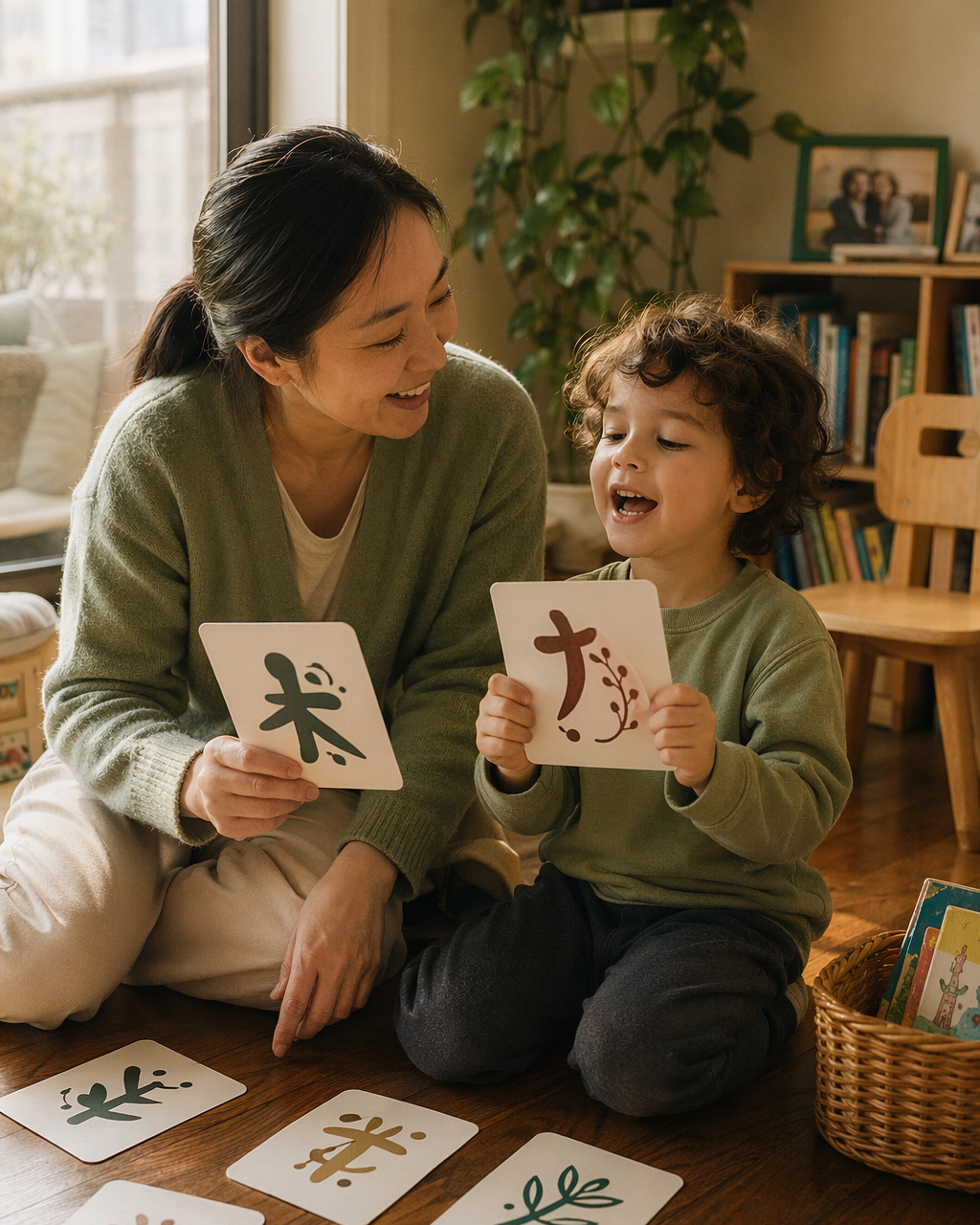
  • 08:30–15:00 — Younger child at home with the nanny: structured play, Mandarin storybook, walk in the FFC plane-tree lanes, lunch, nap. Nanny narrates the day in Mandarin.
  • 15:00–15:30 — School pickup (older child). Children switch to Mandarin with the nanny in the car.
  • 15:30–18:30 — Homework supervision in Mandarin for the Mandarin homework; English homework is the parent's job in the evening. Snack, free play, dinner prep.
  • 18:30–19:30 — Parents home; family dinner; English available between parents and children at the table; Mandarin between nanny and children stays the default.
  • 19:30–20:30 — Bath, story (Mandarin or alternating English/Mandarin with the parent), bedtime.

This is achievable; it is not effortless. Month 3 of the routine sees the older child trying to switch the household to English. The routine has to hold. The bilingual immersion playbook walks through what happens in month 5 when the older child genuinely pushes back, and how the routine survives it.

Common pitfalls — English creep, accent issues, character literacy

Three failure patterns in immersion placements:

  • English creep. The nanny starts switching to English when the children are tired or upset. The children learn that switching to English produces sympathy. By month 4 the household is bilingual-in-name-only. Fix: explicit contract language naming the Mandarin default and the narrow English-fallback cases; day-30 and day-60 check-ins specifically reviewing language adherence.
  • Accent and dialect issues. A candidate with a strong regional accent (Sichuanese, Cantonese-tinged Putonghua, heavy Northeast accent) imprints that accent on young children. If your goal is standard Putonghua for school and future exam contexts, screen for accent in the second-round interview. A regional accent is not a placement disqualifier per se — many candidates with regional accents are excellent. It is something to be aware of and to factor into the choice.
  • Character literacy lag. Spoken Mandarin from immersion does not automatically produce reading fluency. Character literacy requires structured practice that the nanny needs to support. Pair the immersion placement with a Mandarin school curriculum (most international schools include this) and explicit nanny-led character practice — 15–30 minutes/day from age 5 upward.
tip

If the school's Mandarin curriculum doesn't cover characters at the pace you want, layer a Mandarin tutor 1-2x/week. Asking the immersion nanny to also be a structured Mandarin tutor stretches the role; tutoring is a different skill set even for native speakers.

Pairing with a Mandarin tutor or school program

Immersion at home plus structured Mandarin at school is the standard combination for families with serious Mandarin goals. Most international schools in Shanghai offer Mandarin as a daily class — quality varies sharply by school. Three school-program patterns:

  • Strong school Mandarin program (typically 5–8 hours/week of dedicated Mandarin instruction, character work included). Immersion at home plus this is usually sufficient through age 10. No additional tutor needed.
  • Moderate school Mandarin (3–5 hours/week, less character work). Layer a 1–2x/week Mandarin tutor for character literacy and structured reading. Tutor rate ¥ 250–400/hour for qualified candidates.
  • Weak or token school Mandarin (<3 hours/week, ABC-level even for fluent speakers). Both a tutor and structured nanny-led practice are needed. Total weekly Mandarin contact target: 25+ hours including immersion conversation, structured practice, and tutoring.

Which school your child attends materially affects how the immersion placement is scoped. Talk through the school question in the role-scoping conversation.

Contract Clause Cards Placeholder

Four contract elements specific to bilingual immersion placements. Card grid renders below.

Measuring outcomes after 6 and 12 months

How to know whether the placement is working. At month 6:

  • Spontaneous speech. Does the child initiate conversation in Mandarin without prompting? Measure by counting Mandarin vs English initiations in a 30-minute observed play session.
  • Vocabulary depth. Can the child name everyday objects (food, body parts, household items, colors, numbers 1–100) without hesitation in Mandarin?
  • Listening comprehension. Can the child follow a 5-minute story read aloud in Mandarin without comprehension-blocking gaps?
  • English-default fallback frequency. How often does the child switch to English with the nanny? Should be <10% of nanny-child conversation by month 6.

At month 12:

  • Mandarin storybook reading aloud. Age-appropriate.
  • Character recognition. At least the most common 300 characters by age 6, 800+ by age 8.
  • Conversation with a stranger. Can the child hold a 5-minute conversation in Mandarin with an unfamiliar adult? This is the practical test of whether immersion has produced functional fluency vs household-only competence.

The full measurement protocol — including the script for the conversation-with-a-stranger test — is in the bilingual immersion playbook.

2026 monthly bilingual-immersion compensation by neighborhood and tier

NeighborhoodEntry (¥)Mid (¥)Senior / bilingual (¥)
Former French Concession14,000–17,00017,000–20,00020,000–24,000
Xintiandi13,500–16,50016,500–19,50019,500–23,000
Jing'an13,000–16,00016,000–19,00019,000–22,500
Pudong (Jinqiao/Lujiazui)12,500–15,50015,500–18,00018,000–21,500
Hongqiao12,000–14,50014,500–17,50017,500–20,500
Minhang11,500–14,00014,000–17,00017,000–20,000

Contract essentials

Mandarin-default language clause

Explicit contract language naming Mandarin as the household default for nanny-child interaction and the narrow cases where English is permitted (safety, illness, direct parent engagement). Without this clause, English-creep by month 4 is the default failure pattern.

Immersion tier & credential verification

State the candidate tier required (native-functional, genuinely bilingual, or immersion specialist) and what credentials were verified — ECE qualification, prior immersion household experience, accent screening. Tier misalignment is the top dissatisfaction pattern at this pillar.

Structured practice & character literacy

Daily structured-practice expectations: 15-30 min character work from age 5 upward, Mandarin storybook reading routines, vocabulary practice cadence. State whether the nanny is expected to coordinate with a Mandarin tutor or school program — tutoring is a different skill set and should not be assumed.

Month 6 & month 12 outcome review

Scheduled formal review at month 6 (spontaneous-speech, vocabulary depth, English-fallback frequency) and month 12 (story reading, character recognition, conversation-with-a-stranger test). Reviews tied to salary review at month 12 — immersion delivery is the basis of the premium.

Frequently asked

Common questions about this placement

Is full Mandarin immersion realistic with one nanny?
Yes, if the nanny is the right tier (bilingual immersion specialist), the household routine supports the default, and the family is committed to holding the default at the moments where it's easy to slip. Realistic outcome: functional Mandarin fluency by month `12`, with character literacy lagging by `12–18` months — fix that by layering school plus tutoring.
How much more does a fluent-bilingual nanny cost?
`30–50%` premium over standard live-in band. A `¥ 13,000/month` standard placement becomes `¥ 16,500–19,500/month` at the immersion tier for the same profile in the same neighborhood. The premium pays for smaller candidate pool and higher candidate negotiating leverage.
Should we worry about accent or character literacy?
Accent: only if your goal is standard Putonghua for school/exam contexts — screen during the second-round interview. Many regional accents are excellent caregivers and the accent is not a disqualifier. Character literacy: yes — spoken immersion does not produce reading fluency automatically. Plan for school + structured practice + occasional tutoring.
Can the same nanny teach a 3-year-old and a 7-year-old?
Yes — most immersion specialists are comfortable across the `2–8` age range. Beyond age `8`, the role shifts toward homework supervision and structured tutoring, which is a different skill set; you may want to layer a Mandarin tutor by then.
How do I measure my child's Mandarin progress?
At month `6`: spontaneous-speech ratio, vocabulary depth, listening comprehension, English-fallback frequency. At month `12`: story reading, character recognition, and the conversation-with-a-stranger test. Full protocol in the [bilingual immersion playbook](/case-studies/bilingual-immersion-household-playbook/).

In plain English:a Mandarin-immersion nanny costs 30-50% more than a standard live-in (¥ 12,000-22,000/month), keeps Mandarin as the household default, and is the only structural choice that actually delivers native-quality Mandarin at home.

Next step

Scope bilingual immersion with the tier distinction up front

Twenty minutes, free. We separate "bilingual nanny" from "immersion specialist" before any agency is briefed — the wrong tier costs you 6 months.

Bilingual Mandarin-Immersion Nanny Placement — Shanghai — how it works
Background checks via partner agencies
Mandarin and English-speaking advisor
Concierge advisory, not staffing agency
No upfront fee — pay on successful placement
Years of expat-family network in Shanghai
Request a consult

Request a placement consultation

Tell us about your family and what you're looking for. We reply within one business day, with practical next steps — not a sales pitch.

By submitting you agree to be contacted by ShanghaiNanny once with a reply. No spam, no sharing with third parties. See Privacy.