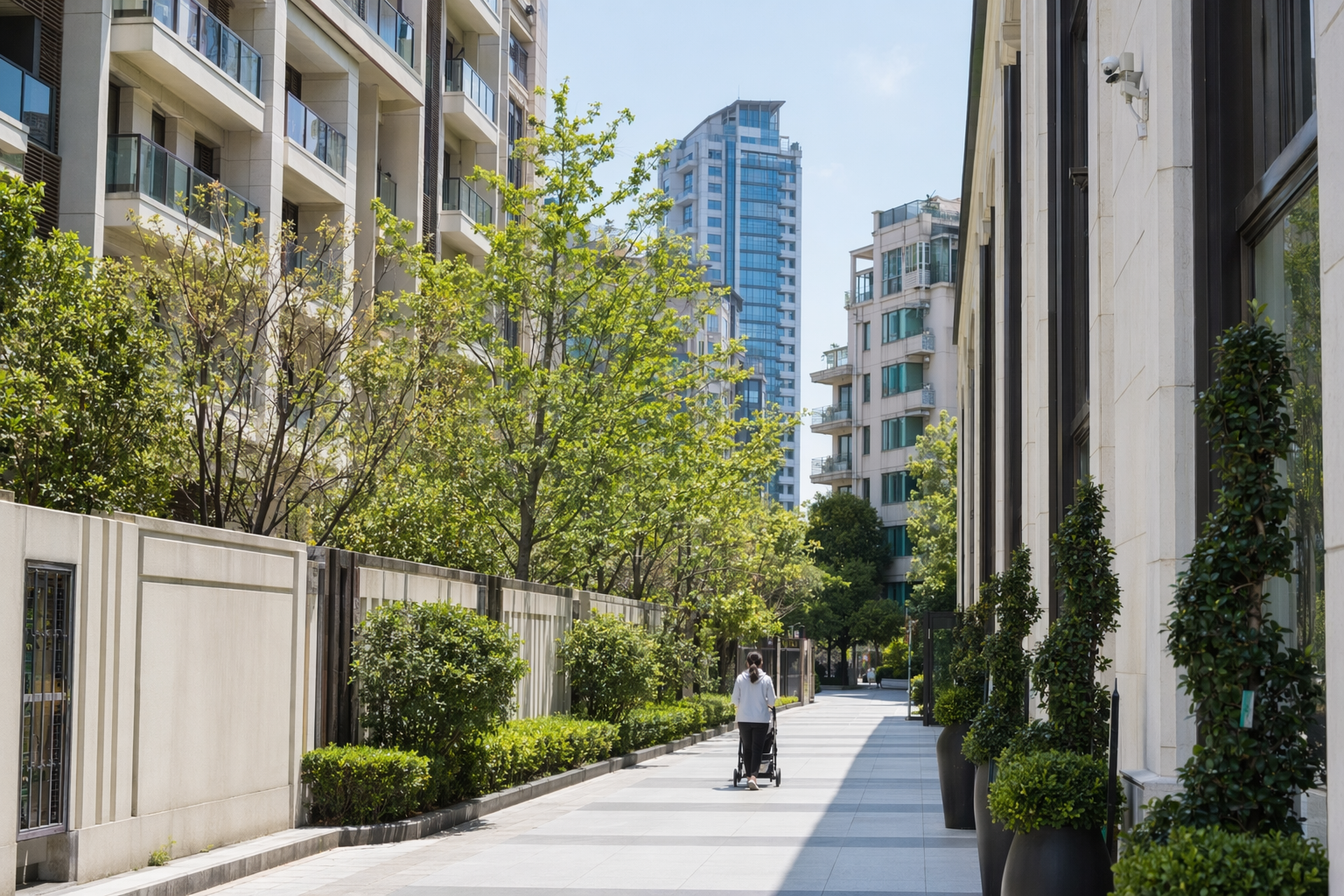
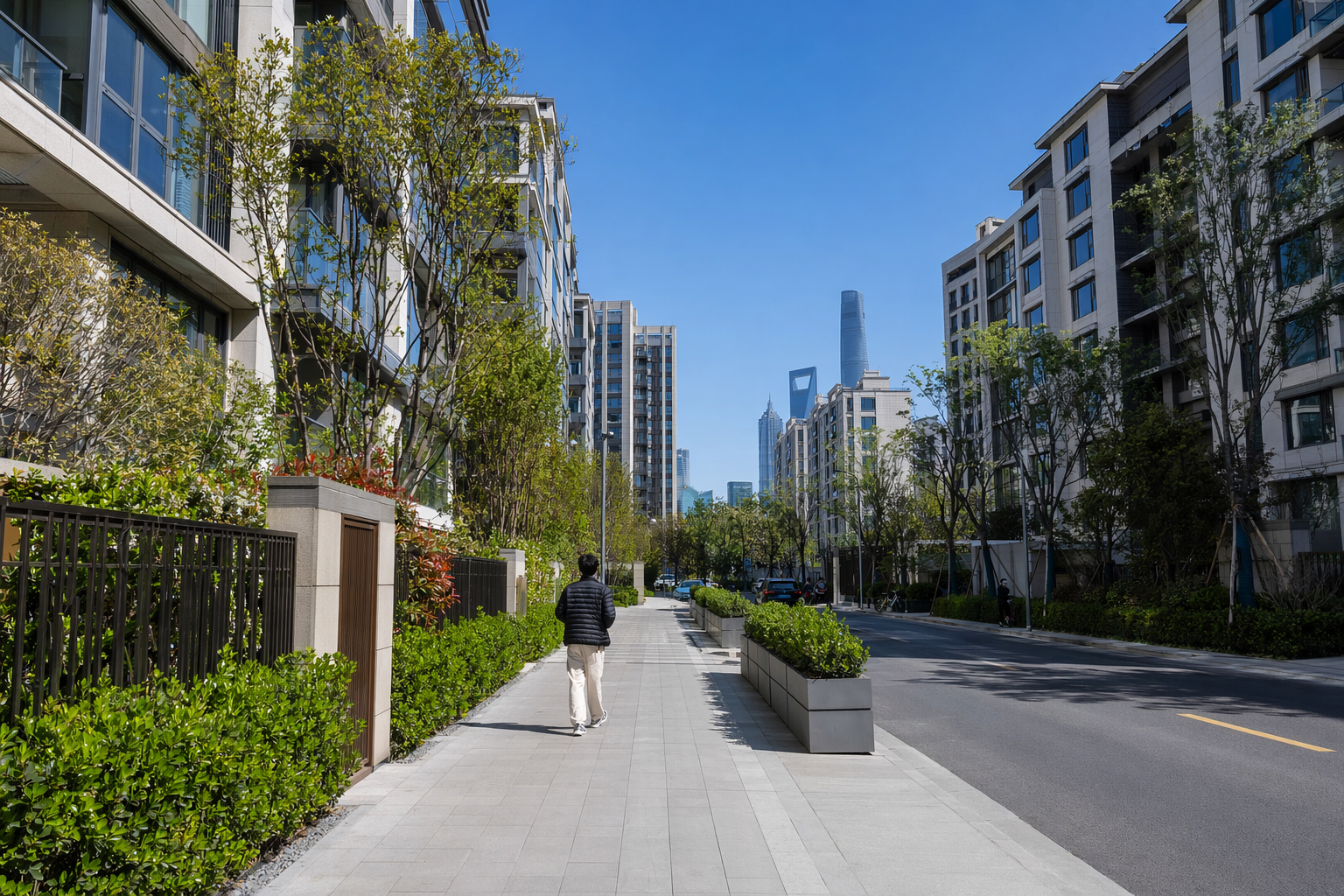
Where the family lives shapes the nanny placement almost as much as the role itself. The lane-house street grid of the Former French Concession constrains scooter and bicycle access for candidates commuting from outer districts, which pushes the salary 18–22% above citywide median. Pudong's larger candidate pool and predictable international-school schedules produce placements that sit at or slightly below median. Minhang's depth of school-experienced candidates sits at the cost end of the spectrum but with longer commutes. Xintiandi luxury apartments have specific live-in feasibility constraints around room layout. Hongqiao is a newer expat pocket with growing supply but smaller-than-FFC premium. Each neighborhood produces a different placement-fit calculus. This page walks through the six neighborhoods most expat families live in, with 2026 supply, commute, live-in feasibility, and salary patterns for each.
Why neighborhood matters for nanny placement
Four neighborhood variables actively shape the placement, separate from the role itself.
- Candidate supply. How many qualified nannies live within a commutable radius of the address. Higher supply lowers the premium and shortens the hiring timeline.
- Commute reality. Whether the address is accessible from outer-district candidate housing by metro, by scooter, by Didi. Inaccessible addresses pay a commute premium baked into the salary.
- Live-in feasibility. Whether the apartment has a separate room with a closing door (and ideally en-suite or near-en-suite bathroom access) suitable for live-in. Some prestige addresses fail this test, which forces live-out at higher commute cost.
- School proximity. For families with school-age children, distance to the international school. Pudong, Minhang, and Hongqiao addresses are closer to most international schools; FFC and Jing'an are usually a
20–40minute Didi away.
The overall pattern: high-prestige central addresses (FFC, Xintiandi) carry the largest neighborhood premium because supply is constrained and commute friction is real. Eastern and suburban addresses (Pudong, Minhang, Hongqiao) carry lower or zero premium because supply is deeper and schools are nearby. Jing'an sits in the middle.
For the salary-band math behind these patterns, see the salary bands page which has the citywide median tables. This page is the address-by-address texture that the bands sit on top of.
Former French Concession (FFC) — lane houses and commuting reality
Salary premium: +18–22% above citywide median. Candidate supply: constrained. Live-in feasibility: mixed.
The Former French Concession (原法租界) covers a roughly 5km² area centered on Wukang Road, Anfu Road, Yongfu Road, and the surrounding lane-house grid. It is the most architecturally distinctive expat neighborhood in Shanghai — plane-tree-lined streets, three-and-four-story lane houses in 1920s–1930s European-influenced design, ground-floor cafes and boutiques behind iron gates.
What this means for nanny placement:
- Live-in feasibility is mixed. Lane-house apartments vary enormously. The renovated upper-floor flats of restored lane houses often have a small servant's-room (
亭子间) that works as a candidate room — small, no en-suite, sometimes no window onto the street. Newer high-rise apartments within FFC (the few that exist, mostly along Huaihai Lu and parts of Changshu Lu) have proper room layouts. The first conversation with a candidate should include a candid description of the room. Many candidates will decline live-in in an unfavorable lane-house room. - Commute is harder than the metro map suggests. The neighborhood is well-served by Lines
1,7,10,12, and13, but the lane-house street grid is narrow, often pedestrianized in segments, and unfriendly to scooters. A candidate living in eastern Pudong who would commute by scooter to a Lujiazui address has to abandon the scooter for a Didi or metro into FFC, adding15–25minutes each way. - Candidate supply skews older and more experienced. FFC families typically hire candidates with
5+years of expat-family experience; junior candidates rarely commute this far for a placement. - Schools are not local. Most international schools are in Pudong, Minhang, or Hongqiao. FFC families either accept a
30–45minute school commute via Didi or hire after-school ayi for the pickup leg.
Salary patterns:
- Standard nanny:
¥ 11,000–17,000/monthlive-out,¥ 12,000–19,000/monthlive-in. - Bilingual immersion:
¥ 15,000–25,000/month. - Cleaner-only ayi:
¥ 7,500–11,000/monthlive-out, hourly¥ 70–130/hr.
When a French family in FFC chooses a Pudong-based candidate willing to commute, the typical compromise is a ¥ 500–1,500/month commute supplement paid as a separate contract line item, keeping the salary comparison clean for future placements.
Jing'an — high-rise expat clusters
Salary premium: +10–15% above citywide median. Candidate supply: good. Live-in feasibility: generally good.
Jing'an district covers a large central area including the Jing'an Temple cluster, the corridor up to Yan'an Road, and the older blocks toward North Bund. The expat-heavy sub-area is the cluster around Jing'an Temple and the high-rise residential towers north and west of it.
What this means for nanny placement:
- Live-in feasibility is generally good. Most expat-occupied Jing'an apartments are post-
2000high-rise stock with proper second-bedroom or maid's-room layouts. Live-in placements in Jing'an are operationally easier than in FFC. - Commute is straightforward. Lines
2,7,12, and14serve the area. Candidates commuting from northern and northwestern outer districts have direct metro access. Scooter access is uncomplicated outside the immediate Jing'an Temple block. - Candidate supply is good. Jing'an attracts candidates because the high-rise stock means cleaner room arrangements, the metro is direct, and the families tend to run more structured schedules than the FFC creative-class baseline.
- Schools are mixed. Some international schools (Wellington, Concordia, BISS) have shuttle service or Didi proximity; others require a
25–45minute commute. - Day-to-day amenities favor the candidate. Wet markets, pharmacies, parks (Jing'an Park itself, Zhongshan Park nearby) are all walking distance. The candidate's quality of life in the neighborhood is good, which lowers the candidate-side friction.
Salary patterns:
- Standard nanny:
¥ 10,000–15,500/monthlive-out,¥ 11,000–17,500/monthlive-in. - Bilingual immersion:
¥ 13,500–22,000/month. - Cleaner-only ayi:
¥ 7,000–10,000/monthlive-out, hourly¥ 65–120/hr.
Jing'an placements have the best supply-to-quality ratio for first-time expat families. If you have a choice between FFC and Jing'an for the same role, Jing'an is the easier placement to staff.
Pudong — international schools and the carpool reality
Salary premium: at citywide median, or −5% below. Candidate supply: deep. Live-in feasibility: generally excellent.
Pudong (浦东新区) covers a massive area on the east side of the Huangpu River; expat-family concentrations are in Lujiazui, Century Park, and the school-belt areas around Jinqiao, Biyun, and the Kangqiao stretch. The international-school landscape is dense — SAS Puxi/Pudong, Concordia, Dulwich, Wellington, the Pudong branch of many other schools — and the school schedule shapes family routines and nanny placements.
What this means for nanny placement:
- Live-in feasibility is generally excellent. Pudong apartments are almost universally post-
2000high-rise or villa stock with proper second-bedroom or maid's-room layouts. Live-in placements are operationally straightforward. - Candidate supply is the deepest of any expat-heavy area. Many ayi live in Pudong's eastern and northern fringes; commute by metro or scooter is direct. Supply means lower premiums and faster hiring.
- The international-school carpool window structures the day. Most international schools in Pudong have morning windows of
07:45–08:15and afternoon windows of15:30–16:00. The nanny's day is built around these. Plan the contract around the school schedule, not the other way around. - Schools have shuttle service in some cases. If the family uses shuttle, the nanny role can shift toward in-home routine and after-school care rather than pickup. This is the role type that produces the most placement stability.
- Distance from central Puxi attractions is real. For families who want to be in the cultural-cluster orbit of FFC and Xintiandi, Pudong feels far. For families building life around school + park + apartment, Pudong is the most operationally efficient choice.
Salary patterns:
- Standard nanny:
¥ 9,000–13,500/monthlive-out,¥ 10,000–15,000/monthlive-in. - Bilingual immersion:
¥ 11,500–19,000/month. - Cleaner-only ayi:
¥ 6,000–8,500/monthlive-out, hourly¥ 55–100/hr. - After-school ayi (pickup + dinner + bath,
15:00–19:00):¥ 60–100/hour.
For families with school-age children, Pudong is the operationally cheapest and most supply-rich neighborhood for nanny placement.
Pudong international-school carpool windows are `07:45–08:15` and `15:30–16:00`. The nanny's day is built around these. Plan the contract around the school schedule, not the other way around.
Hongqiao — newer expat pockets
Salary premium: at citywide median. Candidate supply: growing. Live-in feasibility: generally good.
Hongqiao covers a large area in Shanghai's western districts, including the Hongqiao Airport vicinity, the Hongqiao Hub commercial cluster, and the residential corridors stretching south toward Minhang. The expat presence is newer than FFC or Jing'an — substantial growth over the past decade tied to the Hongqiao business cluster and several international schools opening in or near the district.
What this means for nanny placement:
- Live-in feasibility is generally good. Hongqiao residential stock is mostly post-
2005high-rise and villa, with proper room layouts. Some of the gated-community villa estates (别墅) have particularly comfortable live-in arrangements. - Candidate supply is growing but not yet at Pudong depth. Many candidates still commute from northern Shanghai districts; some travel time is involved. The supply growth has been notable over the past
3–5years. - School proximity is excellent for several international schools. Shanghai American School Puxi campus, Yew Chung International, and several others are within Hongqiao's catchment. School commute is short.
- Airport proximity matters for some families. Families with high-frequency international travel often choose Hongqiao for the airport access. This shifts the role toward including travel-day overlap care.
- The villa-estate context produces a different kind of placement. In gated-community villa estates, multiple expat families employ candidates within the same compound, which produces a candidate-side community and informal information exchange that can be useful or complicated depending on the family.
Salary patterns:
- Standard nanny:
¥ 9,500–14,000/monthlive-out,¥ 10,500–15,500/monthlive-in. - Bilingual immersion:
¥ 12,000–20,000/month. - Cleaner-only ayi:
¥ 6,500–9,500/monthlive-out, hourly¥ 60–110/hr.
Hongqiao is the right choice for families prioritizing international-school access, airport proximity, or villa-estate living.
Minhang — the international-school belt
Salary premium: −5–10% below citywide median. Candidate supply: deep, school-experienced. Live-in feasibility: excellent.
Minhang district stretches south of Hongqiao and west of Xuhui, and contains a substantial cluster of international schools (Shanghai American School Pudong campus is here despite the name, Dulwich Pudong, several others) along with substantial expat-family residential development over the past 15 years. Most families in Minhang are there for the schools.
What this means for nanny placement:
- Live-in feasibility is excellent. Most expat-family Minhang stock is villa or large-apartment, with proper room layouts and often en-suite arrangements.
- Candidate supply is deep and school-experienced. Many candidates have worked multiple Minhang school-family placements and know the school schedules, the holiday calendars, and the after-school activity cadence. This is the placement type where 'previous Minhang family' on the CV is a meaningful signal.
- The school-belt routine structures everything. Morning carpool, in-home routine while children are at school, afternoon pickup, after-school activities, dinner, bath. The role is highly predictable.
- Distance from central Shanghai is real. Minhang feels like a suburb. For families who want regular cultural-life access in Puxi, this is a
45–60minute trip. For families building life around school and home, it is operationally the easiest neighborhood. - Hourly part-time roles work especially well here. Some families build coverage from two or three part-time ayi rather than one full-time — pickup ayi, dinner ayi, weekend ayi — taking advantage of the deep school-experienced candidate pool.
Salary patterns:
- Standard nanny:
¥ 8,500–13,000/monthlive-out,¥ 9,500–14,500/monthlive-in. - Bilingual immersion:
¥ 11,000–18,000/month. - Cleaner-only ayi:
¥ 5,500–8,000/monthlive-out, hourly¥ 50–95/hr. - After-school ayi:
¥ 55–95/hour, common pattern across the district.
For a family relocating to Shanghai specifically because of international school enrollment and willing to live in the school catchment, Minhang is the cost-optimal placement choice.
Xintiandi — luxury apartments and live-in feasibility
Salary premium: +20–25% above citywide median. Candidate supply: thin. Live-in feasibility: address-by-address.
Xintiandi (新天地) is the smallest of the six neighborhoods covered here in geographic terms but punches above its weight in expat-family presence. The luxury apartment towers around Lakeville, the Cao Jia Du area, and the Madang Road corridor sit at the top of Shanghai's residential market, and the families living in them set the upper edge of the nanny-salary distribution.
What this means for nanny placement:
- Live-in feasibility varies by address. Lakeville and a few comparable towers have proper full second-bedroom maid's-room layouts; some other premium addresses have only smaller arrangements. Worth confirming before any candidate conversation.
- Candidate supply is thin. Premium-tier candidates self-select toward Xintiandi addresses, but the absolute number of candidates willing to commute into this cluster is small. Placements take longer here than in any other neighborhood.
- Commute is similar to FFC. Direct metro on Lines
1,10,13. Scooter access into the immediate cluster is restricted in places. - Schools are not local. Almost all Xintiandi families have a
30–45minute Didi school commute. The nanny's role is built around the schedule, not the school's location. - Premium-tier candidates dominate the placement pool. Bilingual immersion nannies, governess-tier candidates, and Tier 4 bilingual / native-English nannies are over-represented. The cleaner-only and traditional-ayi tiers are thin.
- Discretion matters. Xintiandi families are often profile-conscious in ways FFC families are not. Confidentiality clauses in the contract should be specific. See contract essentials.
Salary patterns:
- Standard nanny:
¥ 12,000–18,000/monthlive-out,¥ 13,000–20,000/monthlive-in. - Bilingual immersion:
¥ 16,000–28,000/month. - Tier 4 bilingual / native-English nanny:
¥ 18,000–26,000/month. - Governess tier: well-represented here in a way it isn't in other neighborhoods,
¥ 28,000–55,000+/month.
Xintiandi is the right choice for families who want the central-Shanghai luxury-residential context and have the budget for a thin candidate pool. Plan for a longer hiring timeline — 4–6 weeks rather than 2–4 — and brief the partner agency at the start of the process so the shortlist has time to come together. For help pricing a Xintiandi placement specifically, request a consult.
Common questions
Which neighborhood has the highest nanny supply?
Is FFC harder to staff than Pudong?
Where do live-in nannies prefer?
How do schools shape the placement?
Which neighborhood is cheapest for live-out?
In plain English:FFC and Xintiandi pay `+18–25%` for thinner candidate supply and harder commute, Jing'an sits in the middle with good high-rise live-in stock, and Pudong + Minhang + Hongqiao pay near or below median with deeper supply and easier school access — so school-belt families get the most placement for their money.
Place a nanny in your specific neighborhood
Twenty minutes on a call. We will walk through the supply, commute, and salary patterns for your specific address and tell you what the realistic shortlist and timeline look like for your placement.