
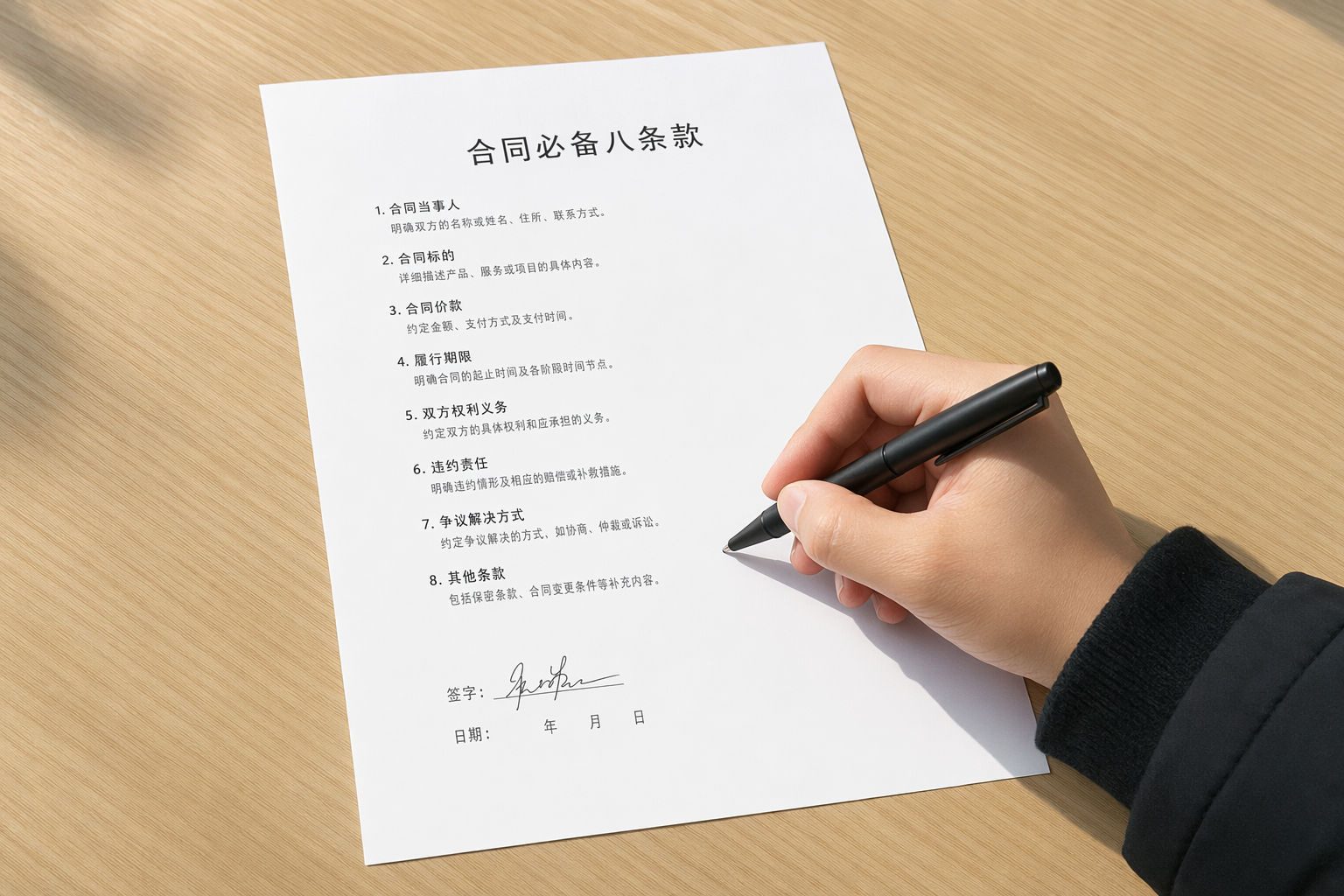
Most Shanghai nanny disputes don't come from bad candidates or bad families — they come from missing contract clauses. A contract that doesn't specify the Chinese New Year red envelope produces a fight in February. A contract that doesn't define the typhoon-day protocol produces a stand-off in July. A contract that doesn't name the governing language produces an unfixable disagreement at termination. This page is the eight-clause checklist that every Shanghai expat-family nanny contract needs in 2026. Each clause includes the wording most often missing, the cultural context Western families don't always anticipate, and the practical consequence of getting it wrong. We are not labor lawyers — for a disputed termination or social-insurance back-payment claim, hire a Shanghai-licensed lawyer — but these eight clauses cover roughly 90% of the cases where a placement that should have worked instead unravels.
Why a bilingual written contract matters even for cash arrangements
Some families in Shanghai operate on handshake arrangements — particularly for cleaner-only ayi roles at the lower end of the salary band. Sometimes that works. More often, it produces small ambiguities that compound into a dispute six months in.
A written bilingual contract is the minimum standard for any placement above the cleaner-only tier. Three reasons:
- The contract is the document that resolves disputes before they escalate. When the candidate says "my last family gave me three weeks off for Spring Festival," the contract is what you point to.
- It signals professionalism on both sides. Candidates who refuse to sign a written contract are often the same candidates who will dispute terms at month four.
- For agency-mediated placements, the contract is what the agency's replacement guarantee is conditional on. No written contract, no replacement claim if the placement fails.
The contract is bilingual — Chinese on the left page, English on the right. The Chinese side is the governing language for any dispute. Both sides must say the same thing; a translation error in either direction is the family's problem to discover and fix at signing, not at termination.
A template contract is on the tools page. We review the contract clause by clause for families as part of the standard advisory service. The clauses below cover the eight things every contract must address.
Clause 1 — salary, payment date, and currency
The first clause specifies base salary, payment date, payment method, and currency. Sounds obvious; the failure modes are subtle.
What the clause must specify:
- Base monthly salary in renminbi. Numerical, in figures and in characters (
¥ 13,000and壹万叁仟元整). Both forms because the character form is what binds in Chinese contract law. - Payment date. Specific calendar day each month.
第10日(the 10th) is most common; some families pay on the 1st of the following month. Late payment is the single most common source of bad feeling in a placement; treat the date as inviolable. - Payment method. Bank transfer, WeChat Pay, or cash. Bank transfer is preferred for placements above
¥ 15,000/monthbecause it produces a paper trail. - Pro-rata language for partial months. Start-month and end-month salary are pro-rated by working days. The clause must say how — typical formula is
(monthly base × days worked ÷ 22). - Currency clause. "Salary is denominated and paid in Chinese renminbi (CNY)." This matters when families try to peg the salary to USD or GBP for relocation accounting; the contract is RMB and any FX risk sits with the family, not the candidate.
What is not in this clause: bonuses, red envelope, food allowance, room valuation. Those belong in their own clauses (7 for bonuses; benefits are usually in an appendix). Bundling them into the base-salary clause produces ambiguity at year-end.
Never agree to pay salary in a foreign currency. If the candidate asks for USD or HKD payment, that is a signal to walk away — it usually means the agency is non-compliant or the candidate's prior arrangement was structured to evade Chinese FX controls. Legitimate Shanghai household employment is paid in renminbi.
Clause 2 — hours, rest days, and on-call expectations
The second clause defines the working hours. This is where most ambiguity hides because Western families think in terms of 9–5 and Shanghai household employment doesn't work that way.
What the clause must specify:
- Daily hours. Start time and end time. For live-in roles, the working day is bounded — for example
06:30–20:00with a2-hour midday break — even though she lives in the apartment. Without the bounded definition, every evening becomes implicitly on-call. - Weekly hours. Typically
45for live-out,60for live-in. The number is what overtime is calculated against. - Rest days. Days off per week, in specific. "One rest day per week, normally Sunday" is the standard. For live-in roles the rest day is non-negotiable; some families do a split rest day (Saturday afternoon + Sunday morning) but the total stays one day equivalent.
- On-call evenings. Whether the family can ask her to stay past the bounded end-time for occasional evening events, the notice period required (
24or48hours typical), and the overtime rate (1.5×hourly equivalent is standard). - Public holidays. Whether she works on Chinese statutory holidays at premium rate, takes them off, or some combination. See clause 4.
- Overtime cap. Maximum overtime per month before it becomes structural.
20hours/month is a common cap.
The failure mode this prevents: the family thinks she is on-call any evening because she lives in. The candidate thinks her day ends at 20:00. By month three this is the dispute that ends the placement. The clause makes it explicit.
Clause 3 — sick leave and statutory holidays
Sick leave for household workers in Shanghai is not governed by the standard 劳动合同法 (Labor Contract Law) because civil-contract household employment falls outside it. That means the family-and-candidate contract is what defines the entitlement.
What the clause must specify:
- Paid sick days per year.
5–10paid sick days per year is the common range. Below5is tight; above10is generous. We default to7. - Unpaid sick days beyond the paid quota. Standard structure: paid sick days exhaust first, then unpaid leave kicks in. The family does not deduct pay arbitrarily.
- Documentation requirement. For more than
2consecutive sick days, a doctor's note (门诊病假单) is required. For1-day sick leave, verbal notice in the morning is sufficient. - Typhoon and severe-weather protocol. Shanghai gets
2–4typhoon-warning days a year. If the local weather bureau issues ayellow/orange/redwarning and public transport is suspended, the candidate does not commute. The day counts as a paid working day, not sick leave. - Family-medical leave. Where the candidate has a serious illness in her own immediate family.
3–5days of paid leave for a parent or child medical emergency is the compassionate norm; some families extend to7days. - Vaccinations and prenatal absences. For yuesao roles specifically, prenatal medical absences in the family the candidate is supporting are handled differently — see yuesao service.
The typhoon clause is the one most foreign families forget. When the first typhoon warning comes through and the family hasn't budgeted for the rest of the day off, the candidate feels (correctly) that the contract is being interpreted against her.
Clause 4 — annual leave and golden-week treatment
Annual leave for Shanghai household workers is one of the most culturally-loaded clauses to negotiate. Chinese statutory holidays cluster into two 7-day "golden week" periods — Chinese New Year (Spring Festival, 春节) in late January or February, and National Day (国庆) in early October — plus a few one-to-three-day holidays through the year. Many candidates expect to return to their home province for some or all of Spring Festival; refusing to allow it produces a permanent rupture.
What the clause must specify:
- Paid annual leave days.
10paid annual leave days per year is the standard for full-time nannies in Shanghai expat households; some premium placements offer15. Pro-rated in year one if the start date is mid-year. - Spring Festival treatment. Either the candidate takes the full
7-day golden week off (paid or unpaid is family choice; paid is the better signal); or she works through it at3×overtime rate per劳动法precedent that is informally followed even in civil-contract household employment; or some combination. Define which. - National Day treatment. Similar to Spring Festival but less culturally charged. Most candidates work through it at premium rate; some take
3–4days off. - Other statutory holidays. Tomb-Sweeping (
清明节), Labor Day, Dragon Boat (端午), Mid-Autumn (中秋). Typically1–3days each; treatment is either day off or premium-rate work day. - Return-to-home-province travel days. For Spring Festival specifically, candidates from distant provinces (Sichuan, Hubei, Guizhou) often need
1–2travel days on either side of the7-day holiday. Build it into the contract. - Carry-over. Whether unused annual leave carries to the following year or is forfeited. Standard is
50%carry-over to year two, with a hard cap of5carried days.
If you cannot accommodate the candidate's Spring Festival travel, you will lose her to a family that can — usually quietly, around month ten. Plan for the absence at signing, not at the end of January.
Clause 5 — termination notice and severance
The termination clause is the one families think about least at signing and most at termination. It defines the notice period, the severance structure, and the probation-period rules.
What the clause must specify:
- Probation period. First
30days of the placement. Either party can terminate with3days' notice and no severance. This is the safety valve for placements that aren't fitting. - Standard notice period. After probation,
30days' written notice from either side. Some contracts specify14days for the candidate (so she can take another offer that requires fast start) and30days for the family (so the candidate has buffer to find the next placement). The asymmetric version is more candidate-friendly and tends to produce better-quality placements. - Severance for family-initiated termination without cause. Standard structure is
1month of base salary per year of service, pro-rated for partial years. So a placement ending at month9would carry a severance equivalent to0.75months of base. - Severance for cause. Specified causes — theft, gross negligence, repeated unauthorized absence — terminate without severance. Define the causes; vague language is unenforceable.
- Severance for candidate-initiated termination. Usually no severance owed by the family; the candidate forfeits any pro-rated annual bonus that would have accrued.
- Return of belongings. Family returns any of the candidate's possessions (including her ID document, if it was held for any reason — which it shouldn't be) within
3working days of termination. - Final pay date. Within
7working days of the last working day. Late final pay is the trigger for most agency-mediated disputes.
The firing and transition page covers the conversation that goes with the clause — how to deliver the notice, how to structure the handoff to a replacement, what to say to your child.
Clause 6 — confidentiality and household privacy
Confidentiality matters because the candidate is in the home, sees the family's routine, knows the children's names and schools, and often has the WiFi password. The clause is not adversarial; it is the boundary that allows the placement to function comfortably.
What the clause must specify:
- Confidentiality of household information. The candidate does not share the family's address, schedules, children's names and schools, financial information, or other private details outside the household. Including in casual WeChat conversations with other ayi.
- Photographs. No photographs of the children may be posted to any social media (WeChat moments, Xiaohongshu, Douyin) without explicit written permission from both parents. This clause produces more friction than any other; many candidates are accustomed to sharing photos casually. Be explicit at signing.
- Phone use during working hours. Bounded phone use — call her own children once a day, respond to family emergencies anytime, no extended personal calls or social-media use during active childcare hours.
- Visitors to the home. No personal visitors to the home (her family, friends, other ayi) without prior agreement. For live-in roles, occasional visits to her room on her rest day are usually fine but should be agreed.
- Confidentiality survives termination. The candidate's confidentiality obligation continues after the placement ends.
12months post-termination is the standard duration; longer durations are unenforceable in civil contract. - Limited NDA scope. Don't import a corporate NDA. Specific items, not catch-all language.
The photograph clause is the single most violated clause in Shanghai nanny employment. Address it directly at signing, in both languages, and follow up at the day 7 check-in.
Clause 7 — bonus and annual review
Bonuses in Shanghai nanny employment cluster around the Chinese calendar, not the Western one. The clause must address both the cultural expectations and the salary-review cadence.
What the clause must specify:
- Chinese New Year red envelope. One month of base salary, paid before Spring Festival travel begins. This is non-negotiable in Shanghai household employment; treating it as discretionary will end the placement. Pro-rated for partial years (some families pay full month from year one as a goodwill gesture).
- Mid-year bonus. Half a month of base salary, paid around the Dragon Boat or Mid-Autumn festival. Optional; common in premium placements.
- Performance-based annual bonus.
0.5–1month of base salary at the family's discretion, tied to the annual review. Decoupled from the Spring Festival red envelope so the candidate cannot lose the cultural minimum due to a tough performance year. - Annual salary review. A scheduled annual conversation (
12-month anniversary or January 1st) where salary is reviewed against the market. Standard increase is5–10%per year for satisfactory performance; the salary bands page is the citywide reference. - Reimbursable expenses. Categories the family reimburses (commute past
45minutes one-way; on-the-job purchases like child's snacks during outings; training and credential renewal costs).
A hard rule on bonuses: the Chinese New Year red envelope is paid regardless of contract end. If the candidate is ending the placement in late January, she still receives the proportional red envelope on schedule. Failing to pay it because the candidate is leaving is the cleanest way to ensure she tells every ayi in your neighborhood that you are a bad family to work for.
Clause 8 — dispute resolution and governing language
The final clause defines what happens when the parties disagree and cannot resolve it themselves.
What the clause must specify:
- Governing language. Mandatory clause: the Chinese version of the contract is the governing language for any dispute. The English version is for the family's convenience. This is standard for any bilingual contract executed in China; without it, a court or arbitrator faced with a disagreement between the two versions defaults to the language of the jurisdiction, which is Chinese.
- First-tier dispute resolution. Direct discussion between the parties, with the agency mediating where applicable.
14days from notice to attempted resolution. - Second-tier dispute resolution. Mediation through the placing agency, where applicable. Most civil-contract household disputes are resolved here.
- Third-tier dispute resolution. Shanghai-licensed civil arbitration or the relevant district court. The clause should specify either arbitration or court jurisdiction; arbitration is faster and quieter, court is binding more strongly. Default to Shanghai No. 1 Intermediate People's Court jurisdiction if no clear preference.
- Severability. If any clause is found unenforceable, the remainder of the contract stands.
- No oral modification. Modifications to the contract must be in writing and signed by both parties.
For placements above ¥ 20,000/month or for any cross-jurisdictional element (foreign-national candidate, employer paying from offshore), have the dispute clause reviewed by a Shanghai-licensed lawyer. For standard placements, the template language on the contract template page is the working baseline. As always, request a consult if you want the contract reviewed clause by clause.
Common questions
Does a nanny contract need to be in Chinese?
Is severance legally required?
What about a probation period?
Can I include a non-compete?
Where can I get a template?
In plain English:a bilingual Shanghai nanny contract needs eight clauses — salary, hours, sick leave, holidays, termination, confidentiality, bonus, and dispute resolution — and the Chinese New Year red envelope is non-negotiable, the typhoon-day rule trips up Western families, and the Chinese version always governs.
Get the bilingual contract reviewed clause by clause
Twenty minutes on a call. We will review your draft contract against the eight-clause checklist and the `2026` Shanghai market norms, in both languages, before you sign.