
This isn't a customer story. We don't publish customer stories. This is a synthesis of how a thoughtful family in a Xintiandi luxury apartment with two young children and a 24-month relocation horizon would build their live-in nanny placement, drawn from interviews with eight expat families across the FFC / Xintiandi / Jing'an corridor and three partner agencies. Names, ages, employer, and identifying neighborhood details are illustrative. The numbers, the calibration cadence, the contract clauses, and the exit framework are all real — they reflect what actually works across the family interviews we built this synthesis from.
The family profile we're working from: two professionals on a 24-month corporate posting, two children ages 3 and 6, both in a Pudong international school (school bus pickup at the Xintiandi-side stop), apartment is a 3-bedroom in a luxury serviced building with a staff bedroom and ayi bathroom. Budget for the placement: USD 3,500–5,000/month all-in. Language requirement: functional English. The placement begins three weeks after arrival and runs the full 24 months.
The setup
Xintiandi as a residential area for expat families is a particular ecosystem. The luxury apartment buildings (Lakeville, Lakeville Regency, Casa Lakeville, Crystal Pavilion) cluster around the South Huangpi Road MTR station and the Xintiandi shikumen-style retail district. The buildings have full concierge, in-building gyms, and — critically — staff bedrooms with separate ayi bathrooms built into the floor plans.
The family we are synthesizing arrives in mid-August, three weeks before the children's school year starts at a Pudong international school. The school bus stop is at the western Xintiandi corner; commute to school is 35–40 minutes via the school's coach service. Both parents work demanding hours — 08:00–19:00 typical — with occasional travel.
The brief sent to the partner agency in week one of arrival reads: 'Mandarin-native, functional English, prior experience with 3–8 year olds, comfortable with international-school-bus routine, willing to do 5 nights live-in with one full rest day per week plus Sunday afternoon off, salary band ¥ 14,000–18,000/month all-in plus standard bonuses, target start date in 21 days.'
The agency shortlist returns four candidates in 9 days. Two are obvious passes after first interview (one lacks the bus-routine experience, one's English is below the brief). Two go to second interview. The selected candidate is 47 years old, has 12 years of expat-family experience including 3 years with a French-American family in the FFC, holds a Chinese Red Cross first-aid certificate (verified), and arrives with two prior-family references who take the call (both confirmed the role and the dates).
The build
The contract is bilingual EN/中文, governing-language Chinese for any dispute (per Shanghai jurisdiction), and uses the 8-clause structure: (1) salary ¥ 15,500/month all-in including food + room, paid 28th of each month via WeChat Pay; (2) hours 06:30–20:00 Mon-Fri, 09:00–20:00 Saturday, full Sunday off plus one weekday afternoon 14:00–18:00 off; (3) sick leave 5 paid days per year; (4) annual leave 7 paid days excluding Chinese New Year; (5) termination notice 30 days post-probation, 7 days during the 60-day probation, pay-in-lieu option for either side; (6) confidentiality clause; (7) 13th-month bonus equal to one month's salary, paid in early January; (8) governing language Chinese.
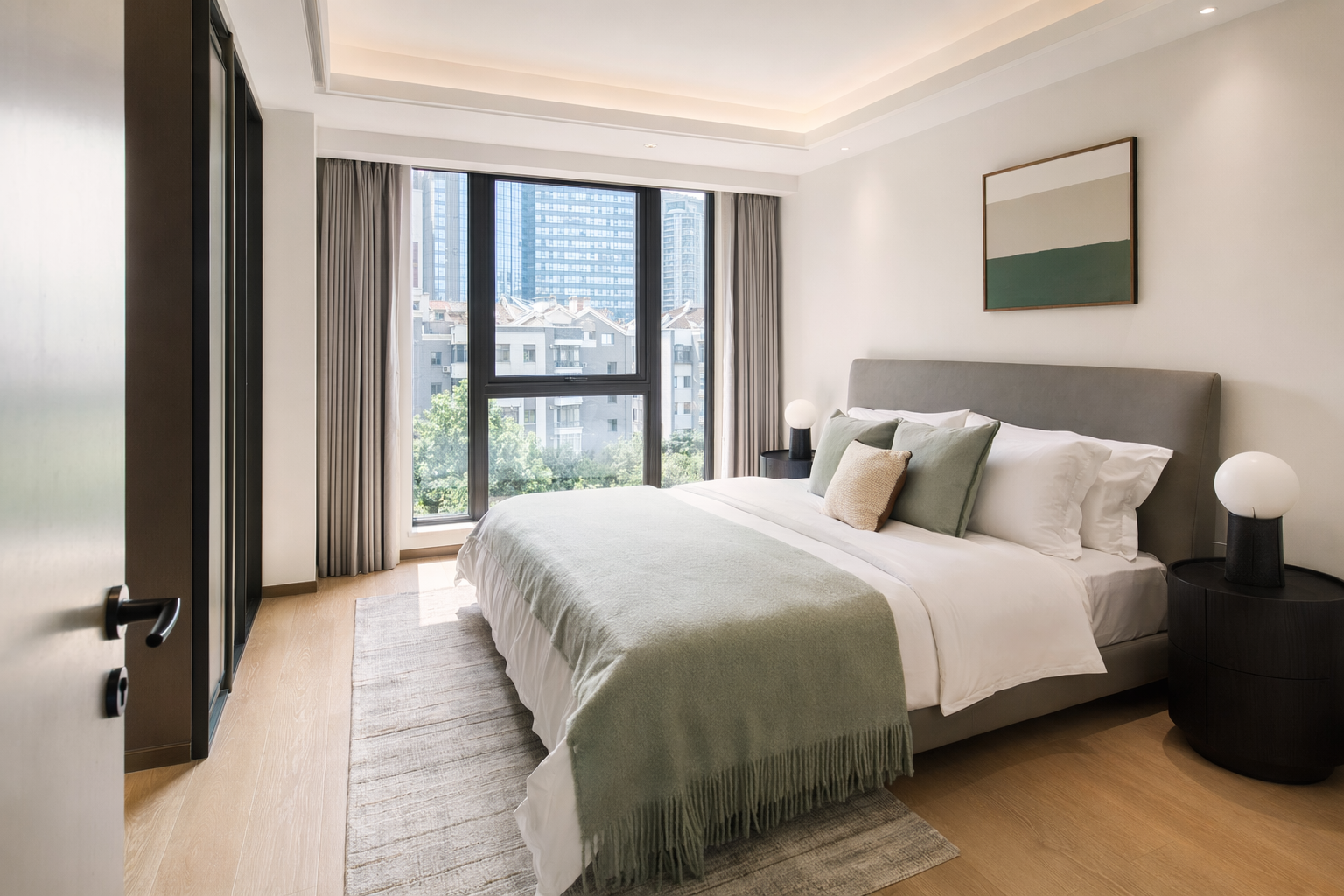
The room: 9 square meters, single bed, wardrobe, small desk, en-suite bathroom with shower. The family pre-installs a desk lamp and pre-buys bedding before arrival.
Calibration sequence: Week 1–4 is the heaviest calibration window. Both parents do a 15-minute Sunday morning check-in with the nanny — non-negotiable, even on travel-disrupted weekends one parent does it solo. Topics: what worked this week, what's been hard, what we want to align on. Week 2 the family co-designs the 7-day rotating menu with the nanny — her cooking input shapes the final menu. Week 3 the screen-time and snack rules are written on a bilingual one-pager and posted inside the kitchen cupboard. Week 6 the family does the first quarterly review: what's well-aligned, what's drifting, what to adjust.
Month 2–6: the placement settles into rhythm. School bus pickup at 07:25 morning and 15:45 afternoon. Homework window 16:00–17:30, mostly for the 6-year-old, dinner prep 17:30–18:30, dinner 18:30–19:15, bath 19:30–20:00, bedtime story 20:00–20:30. Saturday is largely family-led; the nanny handles cooking and laundry. The weekly Sunday check-in continues through month 6, then drops to fortnightly.
Month 7–18: steady state. One mid-year review at month 12 — the family raises the salary by 8% (¥ 1,250/month increase) reflecting tenure and the bilingual ability the nanny has developed alongside the children's developing Mandarin. The family also adds a one-week additional paid leave to the contract.
Month 19–24: wind-down planning begins. The family communicates the departure date 90 days in advance. The nanny is given 60 days' notice formally (longer than contract requires), reference letters are drafted by month 22, an agency conversation about her next placement happens at month 22 with the family's encouragement. Last day arrangements include a family lunch, photo, small gift, and a child-led goodbye letter.
The economics
Annual all-in cost calculation for this placement:
- Base salary year
1:¥ 15,500 × 12 = ¥ 186,000 - Base salary year
2(after8%increase at month12):¥ 16,750 × 12 = ¥ 201,000(technically¥ 15,500 × 6 + ¥ 16,750 × 6 = ¥ 193,500for year2if increase is at exact month12, but rounding up here for the year-2rate after increase) 13th-month bonus year1:¥ 15,50013th-month bonus year2:¥ 16,750- Chinese New Year red envelope (separate from
13thmonth, customary):¥ 1,500each year - Annual training budget (CPR refresher, language course):
¥ 2,000/year - Health insurance (private supplemental):
¥ 3,500/year - Food and household provisions (incremental for the live-in):
¥ 12,000/year - Mid-autumn and birthday gift budget:
¥ 1,500/year
Year 1 total: approximately ¥ 222,000 ≈ USD 30,800 ≈ USD 2,560/month all-in.
Year 2 total: approximately ¥ 238,500 ≈ USD 33,100 ≈ USD 2,760/month all-in.
Placement fee to agency: typically ¥ 12,000–18,000 one-time at start (often equal to one month's nanny salary).
24-month grand total: ¥ 472,500 plus placement fee ¥ 15,000 = approximately ¥ 487,500 ≈ USD 67,700 over 24 months ≈ USD 2,820/month averaged. Comfortably within the USD 3,500–5,000/month budget envelope the family started with — about 40% budget headroom, which the family used for occasional weekend backup care during travel and for the additional training the nanny took mid-placement.
Common pitfalls
Across the eight families we interviewed for this synthesis, the recurring 24-month placement pitfalls were:
- Salary review skipped. Families that don't formalize a salary-review cadence at month
12see one of two patterns by month18: either the nanny becomes quietly demotivated, or she opens conversations with other families through her agency network. A formal5–10%mid-tenure increase is the most reliable retention lever. - Rest-day creep. The full Sunday + Saturday-afternoon rest cadence drifts over the months as the family asks for occasional Saturday coverage. By month
9–12the rest day is often half what it was at month1. Re-enforcing the schedule at month6and month12prevents the slow erosion. - Goodbye starts too late. Families that wait until month
22to discuss the upcoming end leave less time for the nanny to find her next role and less time for the children's transition. Discuss informally at month18, formally at month21. - Reference letter never written. Almost every family interviewed promised one and only half actually delivered before last day. Draft it in month
22; deliver before last day. - Underestimating the home-during-relocation-prep load. The final
30days are unusually demanding — packing, sorting, school exit logistics. Families that add a¥ 3,000–5,000end-of-placement bonus for the final month had materially smoother last-month relationships.
What we'd do differently next time
From the synthesis of family interviews, the patterns that families said they'd repeat — and the ones they'd change:
Would repeat: the bilingual 8-clause contract; the weekly Sunday check-in for the first 6 months; co-designing the menu with the nanny in week 2; the formal month-12 salary review; the 60-day formal goodbye notice; structured agency conversations about the nanny's next role.
Would change:
- Start the agency-conversation-for-next-role earlier. Several families said they'd start at month
18rather than month22. The nanny lands in her next role more cleanly; the family's exit conversation feels less abrupt. - Use a written probation review at day
60. Most families ran the probation period without a written deliverable, then found themselves uncertain whether to convert. A formal written probation review — checklist of10items, scored simply — would have made the decision clearer. - Budget for one trial day before contract signing. A paid trial day costs
¥ 300–500and is the single most diagnostic event in the hiring process. The families who did this had materially fewer surprises at month2. - Lock in the reference letter draft in month
12. Drafting it later is more emotionally fraught and tends to get postponed. A month-12draft, updated at month24, is easier to actually finish. - Plan a more deliberate child-side transition. Families with longer-tenure live-in nannies reported the children took longer to adjust than expected. A more structured by-age conversation plan and a longer post-departure check-in cadence would have helped.
These aren't unique insights — they are the kinds of refinements that families develop over multiple placements and that we have tried to surface in this synthesis. The 24-month live-in arrangement is one of the most rewarding structures for an expat family who has the housing setup for it; it is also the structure that rewards careful design most.
Common questions
Is the family identifiable in this case study?
Can I get the actual contract used in this synthesis?
How much was the all-in monthly cost?
Why does the 24-month arrangement work better than longer or shorter?
Did the families hire someone else after?
In plain English:a `24`-month live-in arrangement in a Xintiandi luxury apartment costs roughly `USD 2,560–2,760/month` all-in. The structure that works: `8`-clause bilingual contract, paid trial day before signing, weekly check-ins for the first six months, formal month-`12` salary review, `60`-day formal goodbye notice.
Want the full bilingual contract and calibration templates?
Our 2026 playbook includes the `8`-clause bilingual contract template, the weekly check-in script, and the salary-review framework from this synthesis.