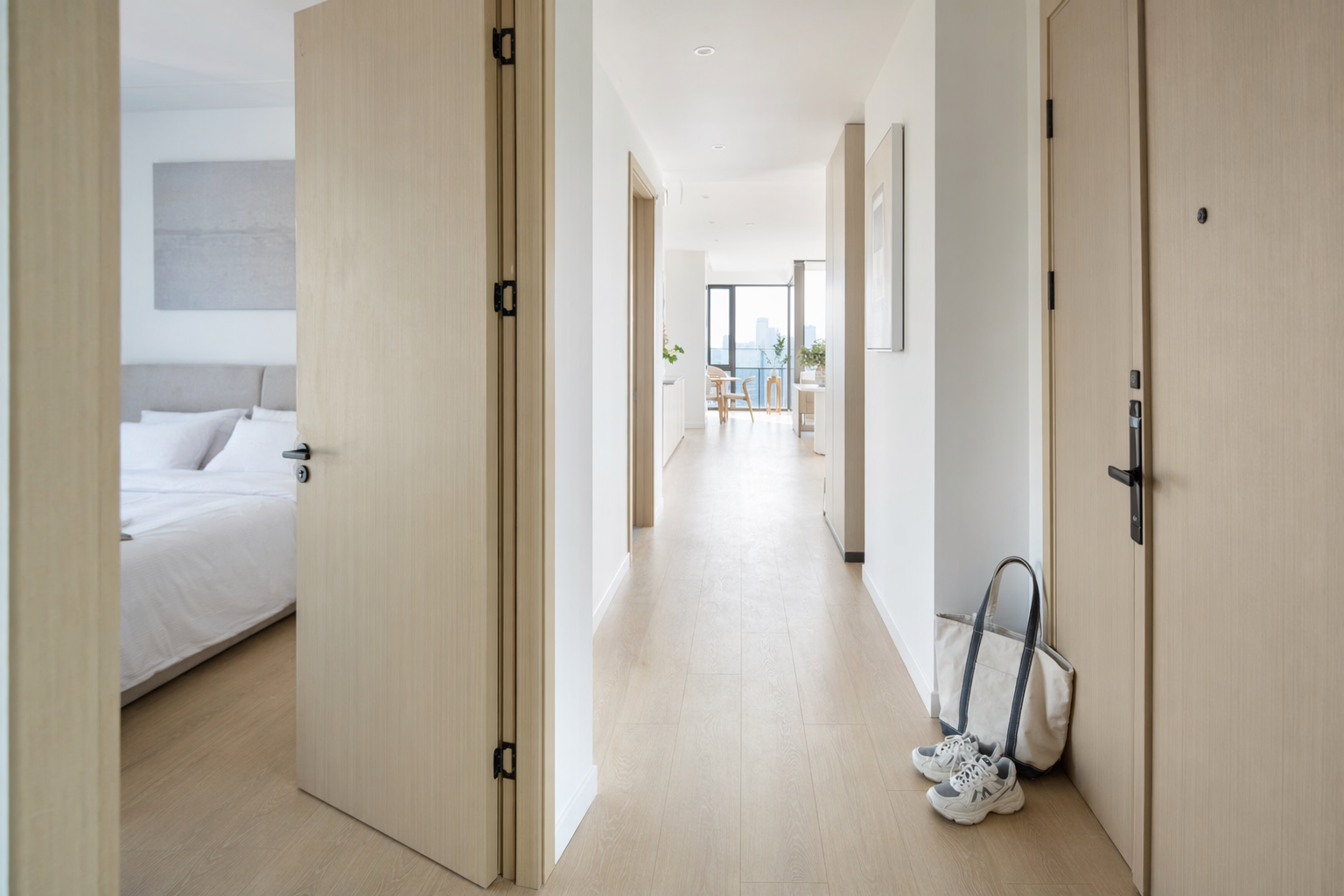
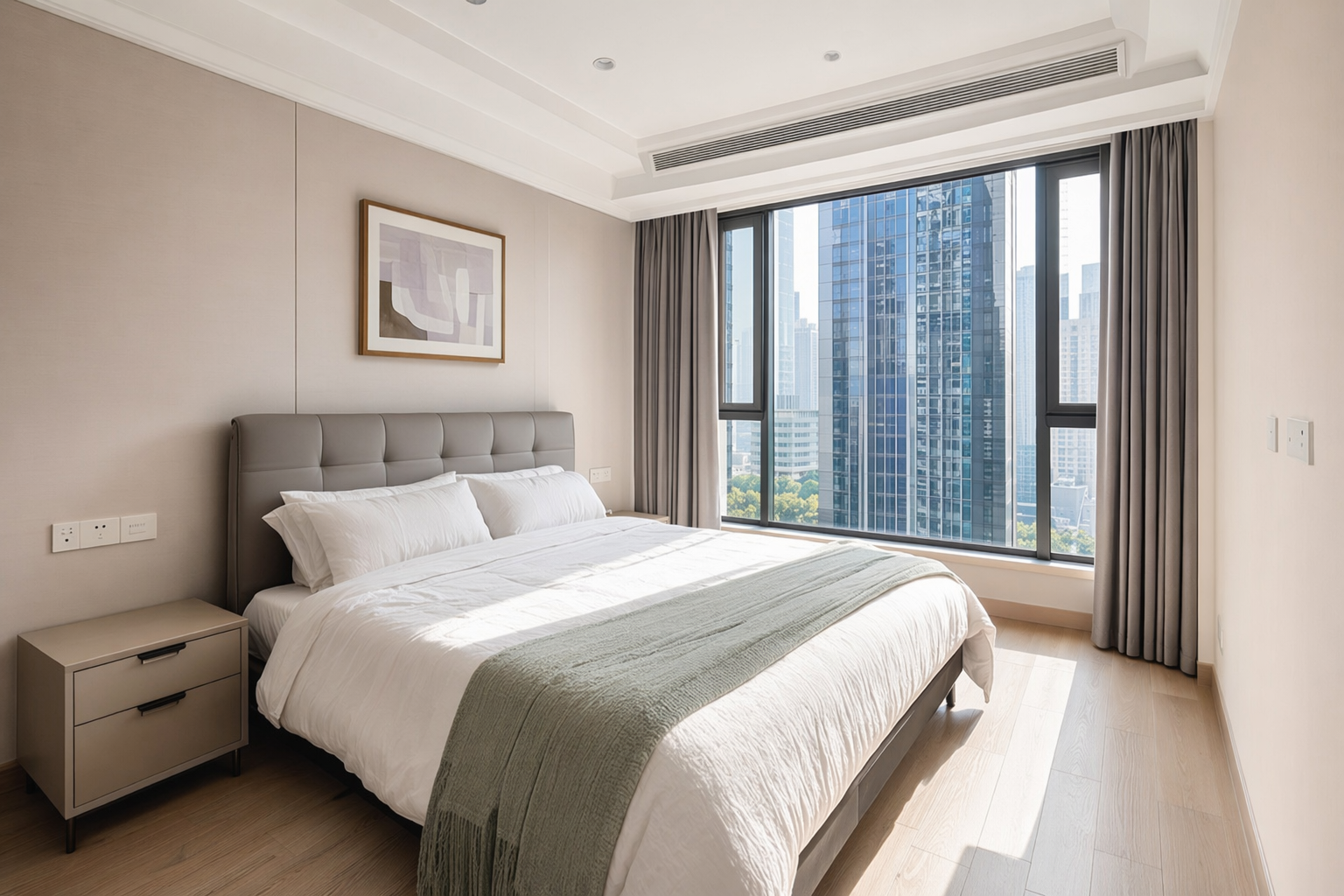
This decision sits inside the full-time nanny family — it does not apply to yuesao (月嫂, yuè sǎo) newborn placements or to part-time ayi (阿姨, ā yí) arrangements. The trade-off is real and runs in both directions: live-in is usually lower cost-per-hour and higher coverage, live-out is usually lower friction on privacy and household space. The right answer depends almost entirely on your apartment and your work pattern.
Side A — Live-in nanny (live-in ayi, 住家阿姨, zhù jiā ā yí)
The nanny sleeps in the apartment, typically in a dedicated ayi room (阿姨房) attached to the kitchen or as a small second bedroom. Standard work pattern is six days on, one day off (sometimes Sunday only; sometimes one-and-a-half days).
Pros
- Evening and overnight coverage built in. Date nights, work travel, and 3 a.m. fevers are someone else's problem first.
- Tighter family integration. The nanny knows the routine end-to-end — feeding, bedtime, allergies.
- Lower total monthly outlay for full coverage compared to live-out plus night nurse.
- Mandarin exposure compounds — dinner-table talk, weekend errands, all become micro-immersion.
Cons
- A second adult in the apartment full-time. Real impact on privacy and couple-time.
- You need the physical room. A Former French Concession (FFC) lane house (洋房, yáng fáng) often does not have one; a Jing'an or Xintiandi serviced apartment usually does.
- Turnover hurts more. When a live-in leaves, you lose a household member, not just a service.
- Local supply is thinner. Many of the most experienced Shanghai ayi prefer to commute home to their own families.
Side B — Live-out nanny (live-out ayi, 走读阿姨, zǒu dú ā yí)
The nanny commutes in daily, usually 7:30 a.m. to 7:00 p.m., five-and-a-half or six days a week. Most live-out ayi live one or two metro lines away — Hongqiao, Jiading, or Pudong's outer rings.
Pros
- Privacy stays intact. Evenings and weekends are yours.
- Bigger talent pool. The most experienced and most senior ayi often prefer to go home at night.
- Cleaner exit. Notice periods are less emotionally fraught when no one is also moving boxes out of a bedroom.
- Smaller monthly outlay for daytime-only families.
Cons
- Genuine coverage gaps. Late dinners, weekend emergencies, sick days, metro disruptions all become your problem.
- Commute eats into productive hours. Typhoon days and Line 2 signal failures happen.
- Per-hour cost is higher than live-in once overtime or weekend cover starts.
- Less natural immersion exposure — the routine is more transactional, less integrated.
Side-by-side — the 2026 numbers
Monthly all-in (base + food + room valuation for live-in). Shanghai citywide medians for a candidate with three to five years of experience and functional English. FFC and Jing'an typically run 15–25% above.
| Dimension | Live-in (住家) | Live-out (走读) |
|---|---|---|
| Base salary, monthly | ¥ 7,500 – 12,000 |
¥ 6,500 – 10,500 |
| Room + board value | included | n/a |
| Hours per week (typical) | ~60 incl. on-call | ~55, daytime only |
| Cost per real coverage hour | lower | higher |
| Privacy impact | high | low |
| Talent pool in Shanghai | smaller | larger |
| Replacement timeline | 14–28 days | 7–14 days |
| Fits FFC lane house | rarely | yes |
| Fits Pudong / Jing'an apartment | yes | yes |
| Bilingual fluency premium | +30–50% on base |
+30–50% on base |
| Mandarin immersion outcome | strong | moderate |
Who picks which
Live-in is the right answer if you (a) have the room, (b) travel for work more than three nights a month, (c) have a child under three, or (d) want Mandarin immersion as a household goal.
Live-out is the right answer if you (a) live in a one- or two-bedroom in FFC or Xintiandi with no second room, (b) value evenings and weekends as private family time, (c) have school-age children who are out of the house 7:45 a.m. to 4 p.m., or (d) are using a yuesao for the newborn window and plan to step down to a part-time ayi after month four.
What we'd recommend (honestly)
For most international-school families with two children under ten and an apartment in Pudong or Jing'an, live-in is the lower-friction answer. For most one-child FFC families with a parent who works from home, live-out is the right call. The hybrid (live-in Monday morning to Friday evening, off weekends) is the underrated middle path — about a 10–15% premium over straight live-out, none of the weekend-privacy cost.
Anyone telling you 'live-in is always cheaper' is doing the wrong math: the bedroom you lose is a real cost, the privacy you trade is a real cost. Both are higher in FFC than in Pudong, which is why FFC live-out is so common despite the supply-side friction.
| Dimension | Live-in (住家) | Live-out (走读) |
|---|---|---|
| Base salary, monthly | ¥ 7,500 – 12,000 | ¥ 6,500 – 10,500 |
| Room + board value | included | n/a |
| Hours per week (typical) | ~60 incl. on-call | ~55, daytime only |
| Cost per real coverage hour | lower | higher |
| Privacy impact | high | low |
| Talent pool in Shanghai | smaller | larger |
| Replacement timeline | 14–28 days | 7–14 days |
| Fits FFC lane house | rarely | yes |
| Bilingual fluency premium | +30–50% on base | +30–50% on base |
| Mandarin immersion outcome | strong | moderate |
Common questions on this comparison
Which is cheaper, live-in or live-out?
Is privacy really a big issue?
Can the same person flex between both?
What about a 5-2 hybrid?
Which is easier to staff in 2026?
In plain English:Live-in is cheaper per hour and gives you evening cover; live-out keeps your weekends private and is easier to exit. If you have the spare room and travel for work, go live-in. If you live in a FFC lane house with no ayi room, go live-out. The hybrid (live-in Monday to Friday, off weekends) is underrated.
Talk through your placement
Twenty-minute call, no fee. Bring the rough budget, the rough start date, and the questions you have not been able to get a straight answer to anywhere else.