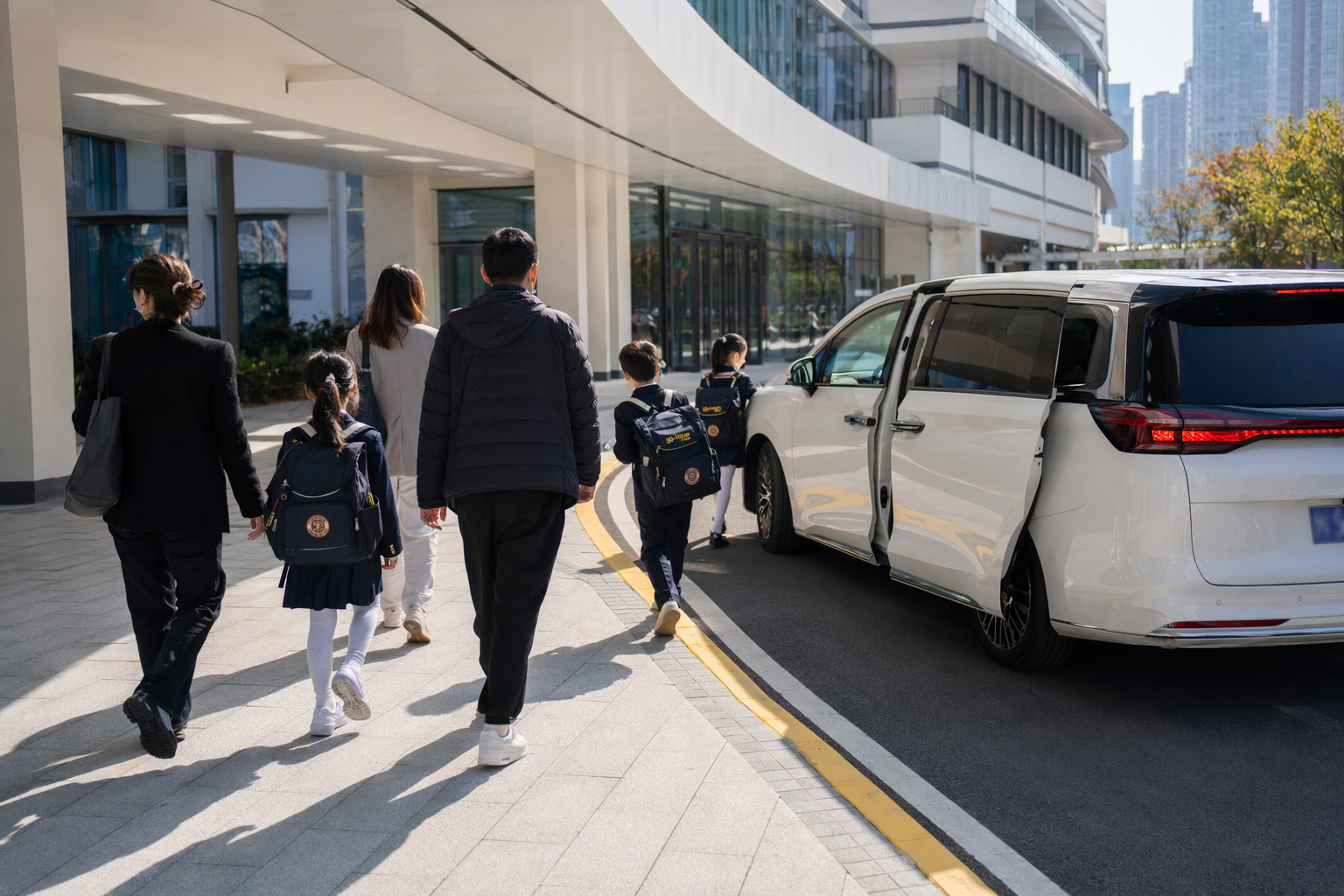
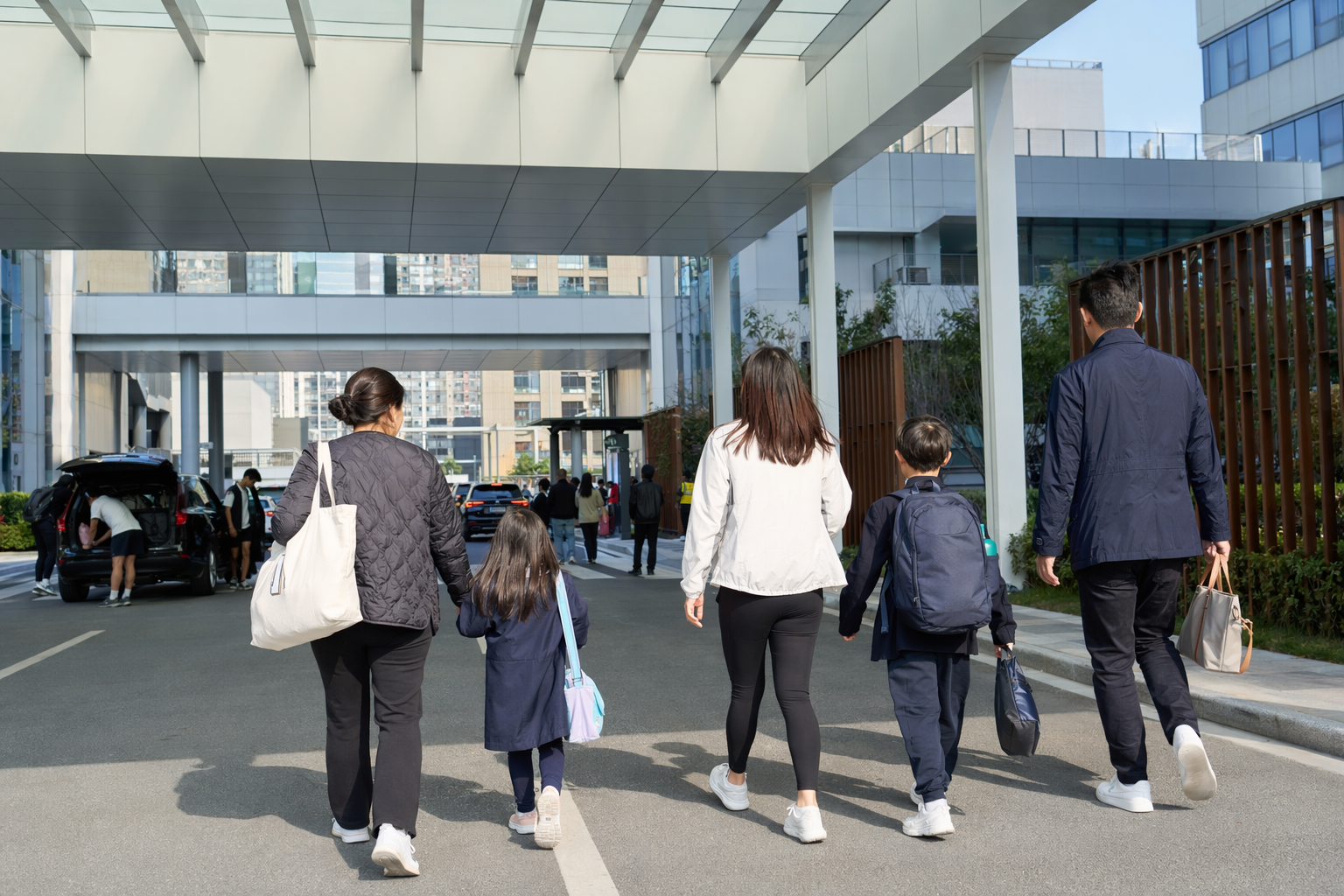
The international-school family is the modal Shanghai expat household we work with — roughly 55% of inquiries. The pattern is familiar: one parent on an international-school-tuition-bearing relocation package, two children in an English-medium school, an apartment in either Pudong's Jinqiao / Kangqiao / Lujiazui ring or Minhang's Hongqiao corridor. The nanny placement question is shaped tightly by the school choice, the carpool window, and the after-school activity schedule.
The household profile
Typical compensation band: total expat package equivalent to USD 250,000 – 600,000 per year including school tuition and housing. The relocation package usually covers:
- Housing allowance:
USD 4,500 – 12,000 / month(covers Jing'an / Pudong serviced apartments or Minhang villas) - Two children's tuition: roughly
USD 60,000 – 90,000 / yearper child at schools like Shanghai American School (SAS), Concordia International School, Dulwich College Shanghai, British International School Shanghai-Puxi (BISS-Puxi), Yew Chung International School (YCIS), or Shanghai Community International School (SCIS) - Annual home leave: usually two business-class round-trip tickets per family member
- Some package of medical insurance, settling-in allowance, language training
- Nanny costs are almost never explicitly itemised in the package, but the expectation is built into the housing-and-allowance scope
Neighborhoods cluster around the school choice. Pudong's Jinqiao expat enclave (greenfield housing compounds with international-school-bus stops at the gate) is the standard. Minhang's Hongqiao-corridor villa compounds (Forest Manor, Westwood Green) cluster around the British and German schools. Jing'an apartments cluster around the city-center international-school commute.
School day typically runs 8:00 a.m. to 3:30 p.m. with carpool windows that constrain the entire family schedule. After-school activities run 3:30–5:30 p.m. on two or three days. Homework windows 5:30–7:00 p.m. Bedtime routines 7:30–9:00 p.m. depending on age.
Schedule pressures specific to this family type
The single biggest schedule constraint is the morning and afternoon carpool window. Pudong international schools running buses out of Jinqiao have pickup windows of 7:30–7:55 a.m. and dropoff windows of 3:45–4:15 p.m. Missing the bus is a real cost — taxi from Jinqiao to SAS-Pudong is about ¥ 80 – 120.
A typical nanny weekday looks like:
- 6:30 a.m. arrival (live-out) or wake (live-in)
- 6:30–7:00 a.m. breakfast prep, lunchbox prep for two children
- 7:00–7:55 a.m. wake children, dress, breakfast, school-bus departure
- 8:00–11:30 a.m. light housekeeping window, errands, grocery shopping
- 11:30–1:30 p.m. lunch + own meal
- 1:30–3:30 p.m. activity prep, snack prep, afternoon errands
- 3:30–4:00 p.m. school-bus return + greeting
- 4:00–5:30 p.m. snack, activity supervision, structured play
- 5:30–7:00 p.m. homework supervision, dinner prep
- 7:00–8:00 p.m. dinner, bath
- 8:00–9:00 p.m. story, bedtime routine for younger child
- 9:00 p.m. parents take over (live-out departs) or evening on call (live-in)
School holiday weeks (October, Chinese New Year, Easter, summer break in late June through August) shift the schedule to full-day at home — typically 7:30 a.m. to 7:00 p.m. continuous coverage. The summer break is the longest single block.
Budget norms and what gets covered by the employer's package
Two-child international-school families typically spend ¥ 9,000 – 15,000 / month on a full-time live-in or live-out ayi. The range reflects whether the placement is bilingual (premium of 30–50%), live-in versus live-out (live-in cheaper for full coverage), and the neighborhood premium.
A representative cost worksheet for a two-child SAS-Pudong family living in Jinqiao:
- Live-out ayi, full-time, functional English:
¥ 9,500 / monthbase - 13th-month bonus prorated monthly:
¥ 790 / month - Chinese New Year red envelope (
红包, hóng bāo) accrual:¥ 800 / month - WeChat-paid taxi / errand reimbursements:
¥ 200 / month - Annual gift / birthday:
¥ 80 / monthaccrual - Effective monthly cost: ~`¥ 11,400`
- Annual: ~`¥ 137,000
(USD 19,000`)
This sits inside the housing-and-allowance scope of most international-school-family packages without explicit line-item negotiation. The exception is bilingual placements at ¥ 14,000+ / month base — those often require explicit budget conversation.
Language priorities — Mandarin immersion vs English continuity
International-school families split into two camps on this question:
Mandarin-immersion families explicitly want home-environment Mandarin to balance the English-medium school environment. The nanny is Mandarin-only or Mandarin-primary. The child achieves real bilingual fluency by age 8 if started under age 4. This is the dominant pattern at SAS, Concordia, and SCIS where the school's Mandarin program is supplementary rather than immersive.
English-continuity families want home-environment English to match the school environment, often because one parent has zero Mandarin and the daily-handoff friction would be too high otherwise. The nanny is bilingual or English-primary. Mandarin exposure happens through the school's Mandarin program and weekend tutors.
Families at YCIS (genuinely bilingual program from year 1) often go Mandarin-only at home — the school covers the English consistency, the home covers the Mandarin reinforcement.
Families at Dulwich and BISS-Puxi (English-medium with Mandarin as a subject) more often go bilingual at home.
Which placement pillar fits best
Full-time live-out ayi is the modal placement for this family profile — about 60% of our international-school-family placements. Live-in is about 25%. Part-time after-school ayi is about 15%.
Live-out wins when the family has reliable backup coverage (working-from-home parent who can flex on sick days), the apartment is in a Pudong compound with good ayi-commute access, and evenings/weekends are valued as private family time.
Live-in wins when there are two or more children under 8, the family travels frequently, the apartment has a dedicated ayi room, or Mandarin immersion is a strong goal.
Part-time after-school ayi wins when one parent is fully home during school hours, the children are 8+, and the household only needs 3:30–7:00 p.m. coverage Monday-Friday.
Common pitfalls for this profile
Three pitfalls we see repeatedly:
- Underbudgeting for school holidays. A part-time ayi at 25 hours per week works during term time, but the 10–11 week summer break needs continuous coverage if both parents work. Plan the summer-coverage structure at hiring, not in May.
- Hiring bilingual when functional English suffices. Paying
¥ 14,000+ / monthfor a fully bilingual nanny when a¥ 9,500 / monthfunctional-English ayi plus a 2-hour-per-week English-language coordinator would deliver the same outcome. - Underestimating the carpool window's tyranny. The 7:30–7:55 a.m. window is non-negotiable. Live-out ayi who commute from outer Pudong can be 10 minutes late on a metro-disrupted day; live-in is the durable solution if the school bus is the binding constraint.
How to start a placement conversation
Send us a note via the inquiry form with: school name, ages of children, target start date, neighborhood, live-in versus live-out preference, and the rough Mandarin-immersion-versus-English-continuity philosophy. We can usually scope a placement to a shortlist of three candidates within 10–14 days. Initial 20-minute call is no-fee.
Common questions for this household type
How is this family profile different from a generic expat family?
What's the typical budget?
Is housing usually included in the relocation package?
Do these families usually go live-in or live-out?
How do school logistics shape the placement?
In plain English:International-school families spend ¥ 9–15k/month on a full-time ayi. Pudong (Jinqiao for SAS, Concordia) and Minhang (for Dulwich, BISS-Puxi) are the school-belt neighborhoods. Live-out wins most of the time but live-in is the durable solution if the 7:30 a.m. school-bus window is non-negotiable.
Talk through a placement for your household
Twenty-minute call, no fee. We will scope what fits your family band, your neighborhood, and your school choice — and tell you honestly when no agency is needed.