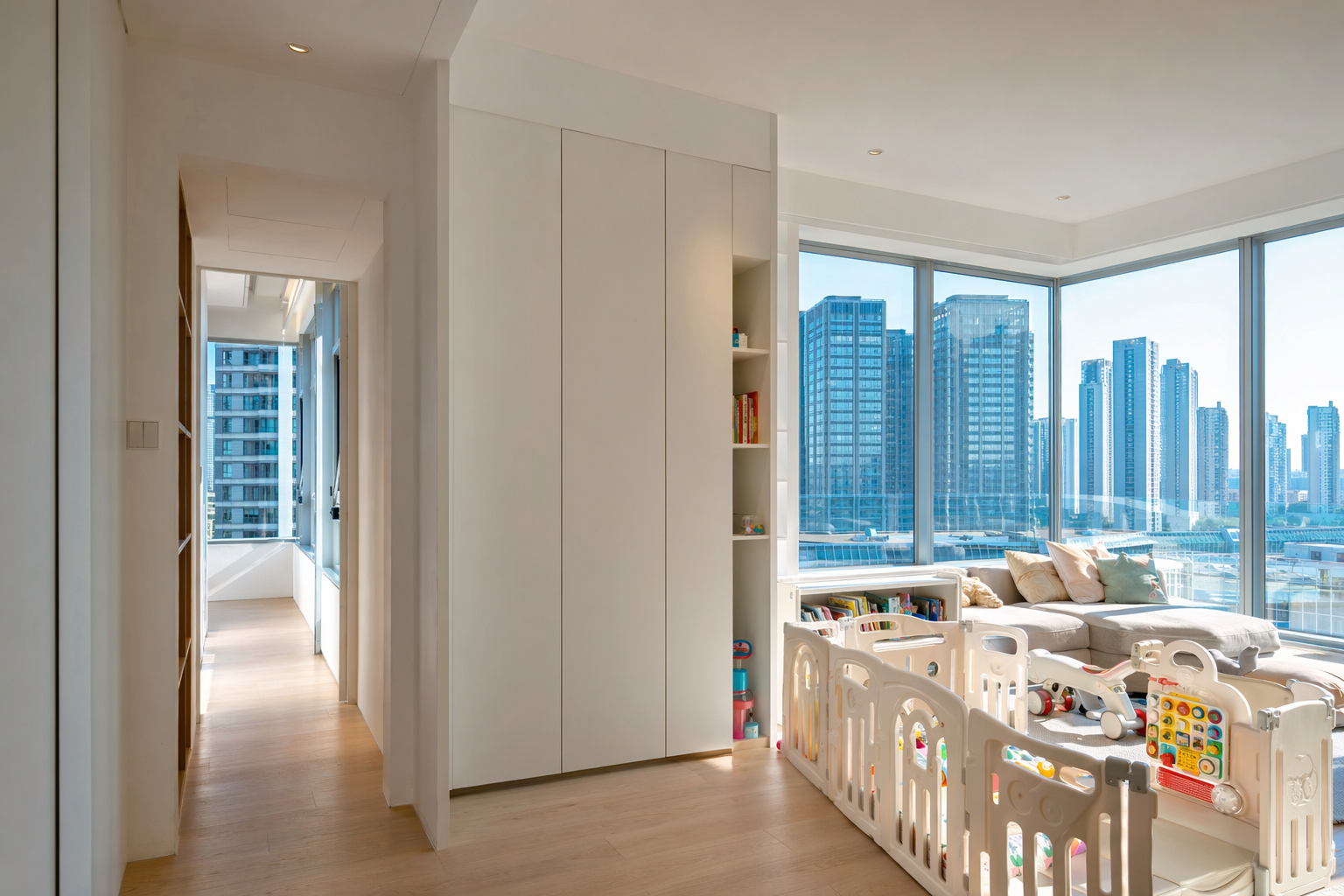
Hongqiao — the area along Hongqiao Road, north of Yan'an West Road, around the Hongqiao high-speed rail and airport hub — has become a meaningful expat-family corridor over the last 36 months. New residential developments, the proximity to both airports, and the school-belt overlap with Minhang have pulled families out of central Shanghai. The ayi supply, however, has not scaled at the same pace. This page is the Hongqiao-specific reality: tighter market, longer search, and a particular set of contract levers that work here.
What 'Hongqiao nanny supply' actually means in 2026
Hongqiao as an expat-family area is a relatively new phenomenon. The residential clusters — around Hongmei Road, in the gated compounds south of Hongqiao Road, and in the high-rises adjacent to the Hongqiao transport hub — have grown materially since 2022. The schools that serve the area split between local Minhang international schools (Britannica, SCIS Hongqiao, Concord) and central Shanghai schools (SAS Puxi, Yew Chung International School).
The nanny labor pool has lagged. Most Shanghai nannies live in the older inner-city residential rings or in the longer-established outer-suburban areas (parts of Minhang south, Songjiang). The Hongqiao area itself has limited ayi-affordable residential, so most live-out candidates commute in from 30–60 minutes away.
Result: candidates are scarcer per family looking, search timelines are longer, and turnover is somewhat higher because commute fatigue compounds over time.
The 2026 reality on the ground
Hongqiao-specific numbers:
- Live-in salary band:
¥ 8,500–16,000/month. Higher than Minhang because supply pressure pushes the band up. - Live-out salary band:
¥ 7,500–13,500/month. Plus commute reimbursement is more common here than elsewhere. - Search timeline:
3–6weeks, slowest of the major expat corridors. - Turnover rate: anecdotally higher than Minhang — commute fatigue is the most cited reason for early exits.
- Live-in fraction: higher than Minhang (commute pressure pushes toward live-in arrangements).
The practical implication: families willing to offer slightly above-band salary, a clean staff bedroom, and a generous rest-day cadence will find candidates faster and retain them longer than families pricing strictly to band. The price-to-retention curve is steeper in Hongqiao than in the established corridors.
What expat families typically get wrong
Common errors:
- Pricing to the citywide band and waiting. In a supply-constrained market, the supply does not increase by waiting. Either price up by
8–12%or extend the timeline by3–4weeks. - Offering live-out when live-in retention would be higher. A
60-minute commute compounds. A staff bedroom and a¥ 1,000/monthhigher salary often outperform a longer search for a live-out candidate. - Skipping the commute reimbursement conversation for live-out. Hongqiao live-out salaries often need a
¥ 400–800/monthcommute reimbursement on top, depending on metro or Didi expectations. Build it into the offer up front, not after the candidate's first month.
Step-by-step — what to do this week
If you're hiring in Hongqiao this week:
- Quote the agency the Hongqiao band, not Minhang or citywide. They should know the distinction.
- Default the role to live-in if you have any flexibility. The retention math favors it.
- If live-out is the only option, scope the commute up front: from where, by what mode, with what reimbursement.
- Extend the search window by
2weeks. Don't fill a tight role with a candidate who's wavering. - Plan for a
60-day check-in specifically about commute fatigue if you've gone live-out. Address it before it becomes the exit reason.
Red flags and what to push back on
Watch for:
- The agency promises a Hongqiao candidate in under
twoweeks without surfacing the commute conversation. They're either pipelining a candidate who'll churn or hiding the issue. - The candidate's stated commute is
<30minutes from her residential — possible but unusual; verify the address. - The salary offered is at the lower citywide band. Hongqiao supply pressure makes the lower band a long-search proposition.
- The candidate has done multiple short placements in Hongqiao. The pattern usually points to commute fatigue, not interpersonal issues.
Common questions
What is the typical answer for Hongqiao nanny supply in 2026?
Is this different for live-in vs live-out?
How does this compare to other Shanghai districts?
What if the agency or candidate pushes back?
Where can I get a contract template that handles this?
In plain English:Hongqiao supply lags demand. Price up `8–12%`, default to live-in where possible, and bake commute reimbursement into the offer up front — not after month one.
Hiring in Hongqiao?
Our 2026 playbook covers the Hongqiao supply reality, the live-in-vs-live-out retention math, and the commute-reimbursement structures that work.