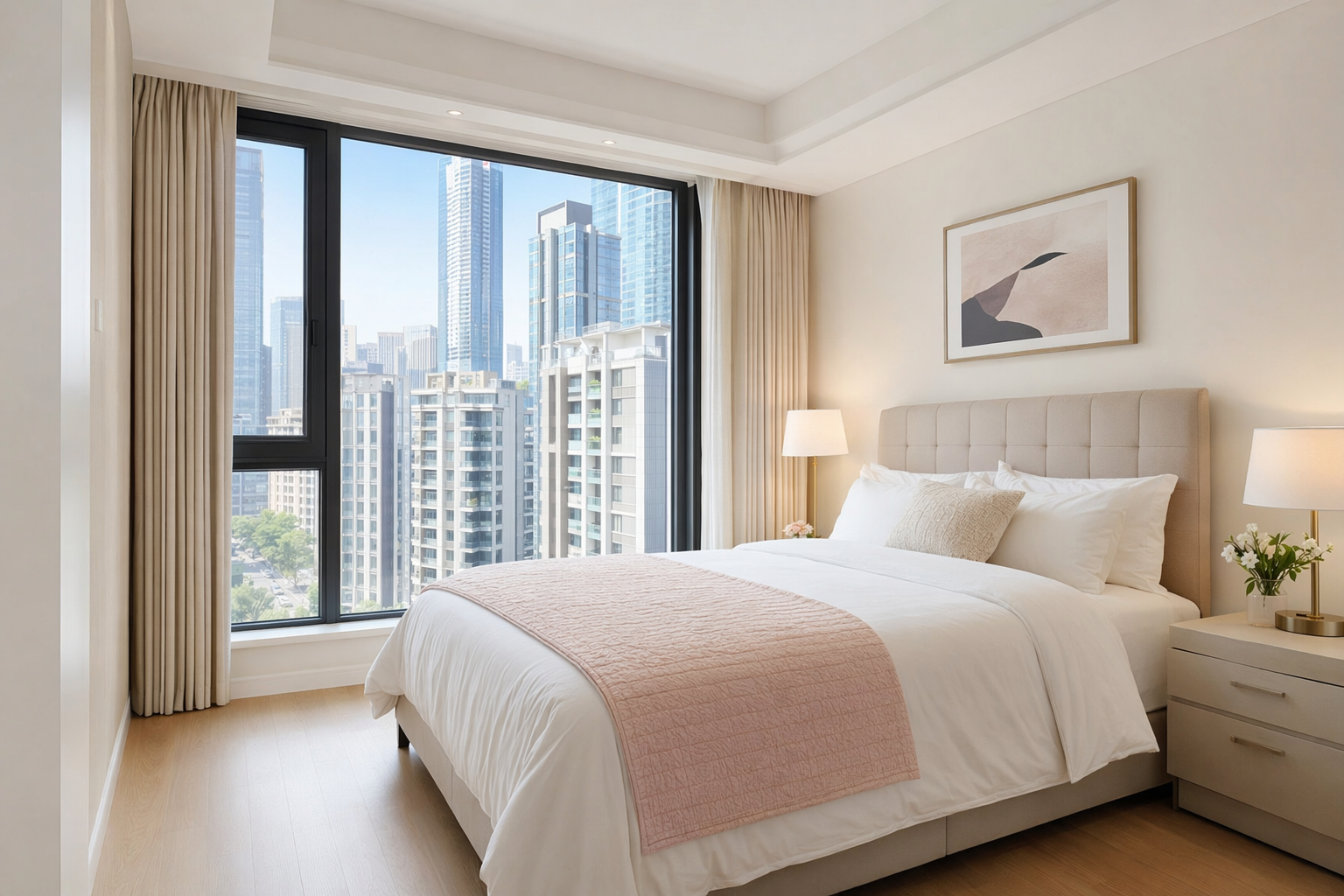
The non-negotiable baseline for a Shanghai live-in nanny's bedroom is her own private room with a door that closes, at least one window with natural light, a bed, basic storage for her clothes, and access to a bathroom she can use without crossing the family's master suite. That's it. About 60% of Shanghai expat apartments naturally meet this baseline (the dedicated ayi room is common in mid-tier buildings); about 30% need a small reorganization to meet it; about 10% either lack the space or are using the spare room as an office and have to choose. Trying to place a live-in nanny in a setup below this baseline — a corner of the laundry room, a curtained-off section of the living area, a child's room — predictably fails by month 3. The other direction (ayi suites with en-suite bathroom and small sitting area) is a premium feature that helps retention but isn't required.
What 'live-in nanny bedroom' actually means
The Shanghai market norm in 2026 is built around the ayi room (阿姨房) — a small bedroom, typically 5–9 m², originally designed by Shanghai apartment architects specifically for a live-in helper. Most mid-tier and upper-tier Shanghai apartments built since the 1990s include one off the kitchen or service corridor. They're small, but they're proper rooms.
The non-negotiable elements:
- A door that closes and locks (or can be latched from inside). Privacy from the family at night and on her rest mornings.
- At least one window. Natural light, ventilation. A windowless interior room is not acceptable as a long-term ayi room.
- A bed. Single bed is fine; bunk beds are not. Mattress quality matters — a sagging mattress will surface in week
4as back pain and resentment. - Basic storage. A wardrobe or freestanding rack for her clothes, a small chest of drawers.
- Bathroom access. She doesn't need her own en-suite, but she needs access to a bathroom without crossing the master suite. The standard pattern is a shared family bathroom (
公卫) separate from the master en-suite. - Climate control. Air conditioning or working heating, same standard as the family rooms.
Nice-to-have but not required:
- En-suite bathroom (premium /
ayi suiteconfiguration). - Small desk for personal use.
- TV or screen for her own viewing time.
- Storage for personal items she brings (suitcase, small shrine for some candidates).
- Soundproofing — useful if her room is near the baby's room and she's not the night nurse.
The 2026 reality — what Shanghai apartments actually offer
Typology of live-in setups across Shanghai expat housing:
| Configuration | % of expat-tier apartments | Notes |
|---|---|---|
Dedicated ayi room off kitchen |
~50% |
Standard in 2000s+ builds; 5–9 m²; meets baseline |
Ayi suite with small en-suite |
~15% |
Premium villas, larger townhouses; comfortable for long-term |
Repurposed study or 4th bedroom |
~20% |
Family converts a spare room; usually meets baseline easily |
FFC lane-house configuration |
~10% |
Varies wildly; some have proper helper rooms, some don't |
| No dedicated space | ~5% |
Studio + 2-bedroom apartments; live-in not feasible |
For Former French Concession lane houses, the helper-room situation is highly variable — some have proper third-floor or basement helper rooms; others have nothing. Confirm before hiring live-in.
For Pudong and Jing'an high-rises, the ayi room is almost universal in 120+ m² units.
For Xintiandi luxury towers, both ayi room and ayi suite configurations are common.
For Hongqiao and Minhang detached / townhouse expat compounds, the ayi suite is the norm in villa-tier housing.
What expat families typically get wrong
- Trying to use a curtained-off corner. "We'll put a screen up and she'll have privacy." She won't. Live-in placements in non-private spaces fail predictably by month
2–3. - The room exists but is full of family storage. Boxes, off-season clothes, a treadmill. Clear it out before she arrives, not in week
2. - No working AC or heating. Shanghai is humid in summer and bone-cold in winter. AC and heating that work as well as in the family rooms are non-negotiable.
- Mattress that's clearly second-hand or sagging. Replace it before she arrives. Costs
¥ 800–2,000, returns the cost in retention easily. - Bathroom logistics are awkward. Her bathroom is across the apartment from her room, through the kids' bedroom. Doesn't work. Either reorganize or hire live-out.
- No window. A windowless interior storage room repurposed as a bedroom is not acceptable. Hire live-out instead.
- Sharing a room with a child. Sometimes proposed for the youngest. Doesn't work — she has no off-duty time and no privacy. Don't.
Step-by-step — what to do this week
- Walk through the apartment with the role in mind. Where will she sleep? Where will she keep her clothes? Where will she shower? Does she have to cross the family's private space to get from her room to the bathroom at night?
- Clear the room. If the
ayi roomis currently family storage, empty it. Buy a small wardrobe if there isn't one. Refresh the mattress and bedding. - Confirm climate control. Test the AC and heating. If they don't work, fix them before she arrives.
- Stock the basics. Sheets, pillows, a duvet, towels. Standard quality, not luxury. Allow her to bring her own bedding if she prefers.
- Show her the room during the trial day. Let her see it and ask questions. If she has practical requests ("could I have a small lamp," "could the wardrobe move"), accommodate.
- Brief the children. Her room is hers. They don't enter without knocking. This is a household culture, not just her constraint.
Red flags and what to push back on
- An agency suggesting a live-in placement when your apartment doesn't have the space. Pushback: "We'll hire live-out instead." Don't compromise on the room.
- A candidate accepting a substandard room without comment. Sometimes signals desperation rather than fit. Worth a frank conversation: "Is this room actually OK for you?"
- The room becomes shared with the baby's nursery for night work. That's a yuesao / night-nurse arrangement, not a standard live-in nanny. Different role, different price.
- Lock removed or door without a latch. Replace before she arrives.
- Children using her room when she's not home. Address immediately. Her room is her space.
A `¥ 2,000` mattress upgrade and a `¥ 300` blackout curtain are the two cheapest retention investments in a Shanghai live-in placement. Most expat families spend `¥ 50,000–80,000/year` on the salary; the room comfort is rounding error and returns the cost in lower turnover.
Common questions
Does she need her own bathroom?
What size room is acceptable?
Can she share a room with one of the children?
What about Former French Concession lane houses with no obvious helper room?
Where can I get a contract template that handles this?
In plain English:she needs her own room with a door, a window, a real mattress, and a bathroom she can use without walking through your bedroom. If you don't have that, hire live-out instead.
Set up the live-in space right before she arrives
We walk through your apartment with you (in person or via video) to confirm the live-in setup before the first interview.