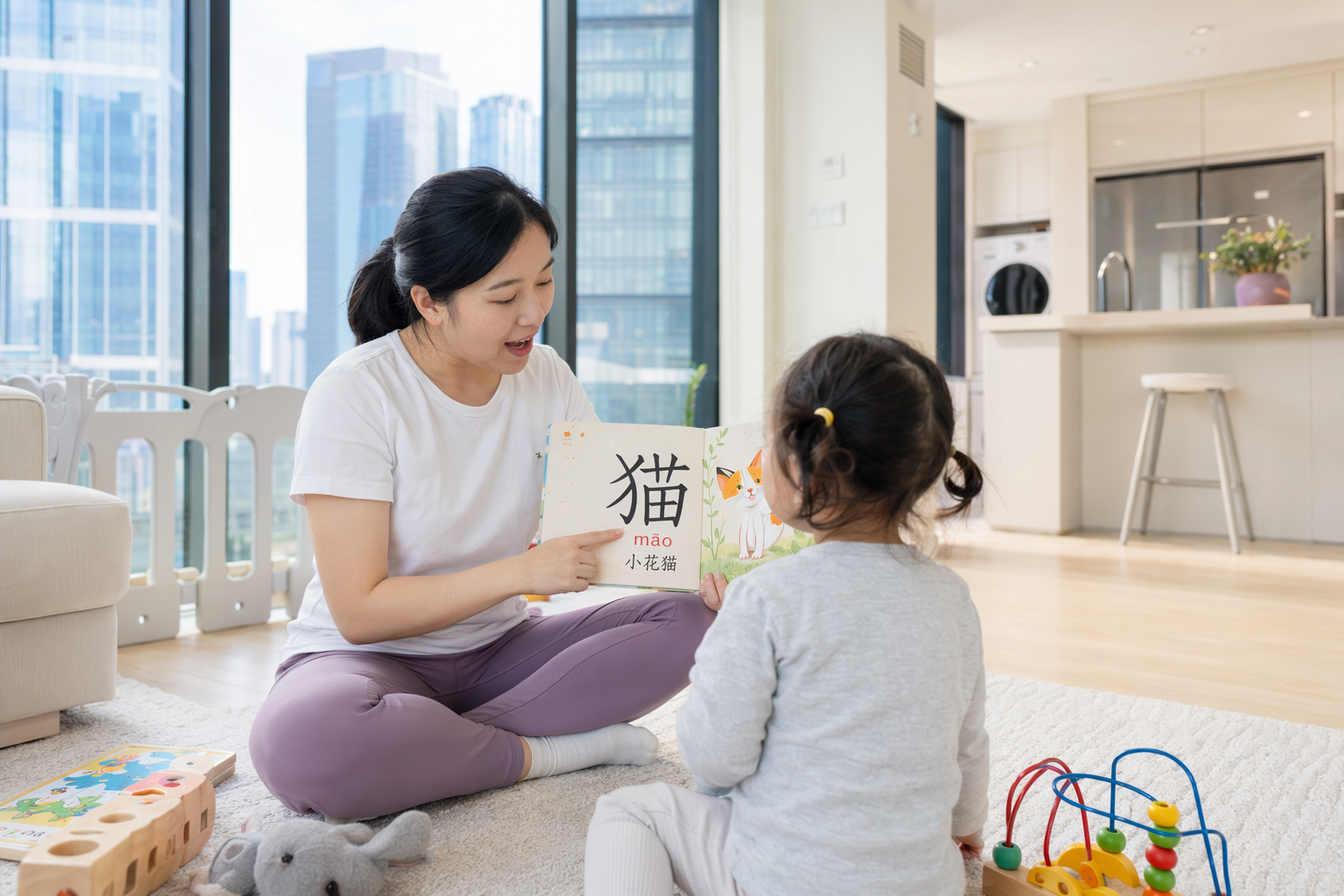
Mandarin character literacy is the single biggest gap in most bilingual Shanghai expat households. The child speaks Mandarin fluently, comprehends fluently, but at age 6 cannot read a children's book — because no one structured the 15 minutes/day of character practice that would have built a 500-character recognition base by school entry. Character literacy is not the same as spoken Mandarin acquisition. Spoken Mandarin builds naturally through immersion; character literacy is taught, structured, and requires deliberate practice. The good news: the daily commitment is small (15–20 min/day from age 3), the methods are well-established (pinyin first, then high-frequency characters, then story-context reading), and the Shanghai-local-school curriculum gives an excellent target framework even for expat children not in mainland-curriculum schools.
What 'mandarin character literacy' actually means for young children
There are three distinct strands that get conflated:
- Pinyin (
拼音) — the romanization system used to teach Mandarin pronunciation. Mainland Chinese first-graders learn pinyin first (typically the first2 monthsof grade1), then move to characters. Pinyin is a stepping stone, not the destination. - Character recognition (
认字) — seeing a character and knowing what it means and how to pronounce it. This is reading. - Character writing (
写字) — being able to produce the character with correct stroke order. Important but secondary to recognition for young children.
The Shanghai-local first-grade curriculum targets approximately 500 characters by end of grade 1, 1,800 by end of grade 3, 2,500 by end of grade 6. International-school curricula (e.g., IB, British) typically target much less — sometimes only conversational Mandarin with minimal characters.
For expat families targeting bilingual literacy comparable to a local Shanghai child, the practical milestones:
- Age
3–4:30–50high-frequency characters (recognition). Start with concrete nouns:人 大 小 上 下 中 山 水 火 日 月 木. - Age
4–5:100–200characters; basic sentence reading. - Age
5–6:300–500characters; simple picture books. - Age
6–7:500–800characters; reading early-grade textbook material.
These are stretch targets for expat children not in a mainland-curriculum school. Half of these is still a strong outcome.
The 2026 reality — the daily 15-minute routine
What 15–20 minutes/day looks like, by age:
| Age | Daily routine | Materials | Target |
|---|---|---|---|
3–4 |
10 min flashcard recognition + 5 min picture-book exposure |
Sagebooks (基础中文) or Le Le Chinese levels 1–2 |
30–50 characters by year end |
4–5 |
10 min flashcard review + 10 min graded reading |
Sagebooks level 2–3; Greenfield Chinese; simple picture books |
100–200 characters |
5–6 |
5 min flashcard + 15 min reading |
Sagebooks level 4–5; mainland grade-1 readers |
300–500 characters |
6–7 |
20 min graded reading + occasional writing |
Mainland grade-1/grade-2 readers; Mandarin Express |
500–800 characters |
The nanny is the executor; she runs the 15–20 minute daily session. The parent's job is to source the materials and stay engaged enough to maintain the routine on her rest day.
Program-led options (in lieu of a self-run routine):
- Sagebooks — Hong-Kong-origin graded reader series; widely used; well-structured progression.
- Le Le Chinese — Singapore-origin; bilingual learner-focused.
- Greenfield Chinese — character-recognition-first methodology popular in Singapore and Mandarin-immersion schools.
- Mandarin enrichment classes — Shanghai has many; typical
60-90 min/session,1–2x/week; supplements but does not replace daily home practice.
Most expat families use a combination — daily home practice with the nanny, plus a 1–2x/week enrichment class for structured progression.
What expat families typically get wrong
- Assuming spoken Mandarin will lead to literacy. It won't. Literacy requires deliberate teaching.
- Starting too late. Families often wait until age
6(school entry), then face a steep cliff because peers have been building characters since3–4. - Skipping the daily routine and relying only on
1–2x/weekclasses. Classes don't build the muscle alone. Daily home practice is what builds reading. - No structured progression. Random character introduction; no review system; characters get forgotten. Use a graded series (Sagebooks, Le Le, Greenfield) or a structured tutor curriculum.
- Pushing writing too early. Recognition first, writing second. Forcing writing before age
5–6adds friction without proportional benefit. - Comparing the child's progress to mainland-school peers. Mainland-curriculum children do
60–90 min/dayof character practice in school plus homework. Expat-school children doing15 min/dayat home cannot match that pace — but they can hit a respectable~50–60%of mainland-curriculum literacy by school entry.
Step-by-step — what to do this week
- Pick a curriculum. Sagebooks for most families. Le Le if your child is younger or you want bilingual scaffolding. Greenfield if you're targeting fluent literacy.
- Order the first
2–3levels.¥ 500–1,500total. Available onTaobaoor via Hong-Kong / Singapore distributors. - Set the daily window.
15–20 minutes, same time each day. After lunch or after school works best — fresh enough to focus, not pre-bedtime tired. - Brief the nanny. Walk her through the curriculum. Most fluent-Mandarin candidates can teach character recognition from a graded series with minimal additional training.
- Sit in for the first
3sessions. Observe; adjust pacing; make sure the structure is working. - Track characters learned. A simple list on the wall. Add one per day; review weekly.
- At
90 days: test. Show the child the first100characters; count recognition rate. Adjust pace based on actual data. - Consider a
1–2x/weekenrichment class to supplement the home routine — especially for ages5+where structured progression matters more.
Red flags and what to push back on
- A nanny who can't read children's books in Mandarin smoothly. Rare among fluent-Mandarin candidates; common among
some-Mandarincandidates. Test directly at interview. - A child who resists the daily routine after
2 weeks. Adjust pace, switch materials, shorten window. Don't push through; back off and rebuild positive association. - A curriculum that introduces characters faster than the child can retain. Slow down. Better to know
50characters solidly than200half-recognized. - Expecting writing competence at age
4. Above developmental norm. Recognition first. - A
tutoror program promising1,000 characters in 6 months. Skeptical. Real-world retention rates are60–80%of new characters at90 days; high-volume programs over-promise.
The single best literacy investment under age `5` is a small library of `20–30` Mandarin picture books at the child's level, plus making the nanny's nightly story routine in Mandarin instead of English. The child sees characters in context every day, the nanny is teaching reading whether she labels it that way or not, and the routine costs `¥ 500` total.
Common questions
When should we start character literacy?
Is this different for live-in vs live-out?
How does this compare to other Asian expat hubs?
What if the agency or candidate pushes back on adding character literacy to her role?
Where can I get a contract template that handles this?
In plain English:spoken Mandarin doesn't equal reading Mandarin. `15 min/day` of structured character practice from age `3` gets you to `500` characters by school entry — but you have to actually do it daily.
15 minutes a day, from age 3, gets you 500 characters
We help bilingual-immersion families set up the daily character-literacy routine — curriculum choice, materials, nanny briefing, monthly tracking.