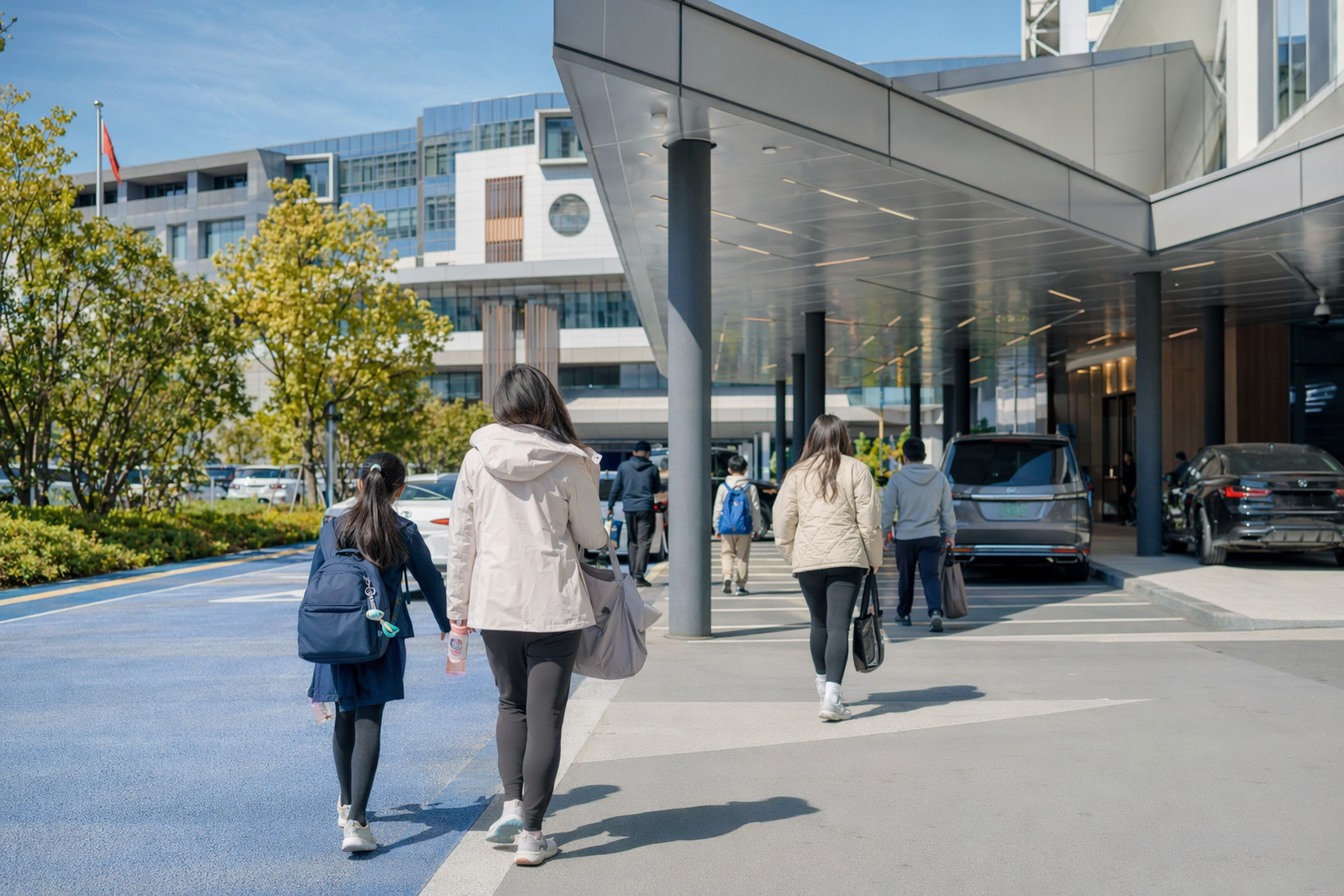
Minhang district sits west of central Shanghai and contains a dense belt of international and bilingual schools — Shanghai Community International School (SCIS), Britannica International School, Concord International School, Livingston American School, plus several Mandarin-immersion bilingual options. Expat families who relocate here are usually optimizing for school commute first and lifestyle second. The ayi market reflects that: supply is higher, salary bands run 10–15% below FFC/Jing'an, and the role is almost always shaped around the school calendar. This page is the practical Minhang layer.
What 'Minhang international-school belt' actually means
The Minhang school belt is the cluster of 7–9 international and bilingual schools concentrated within roughly 15–20 minutes of each other along the Hongmei Road / Yindu Road corridor and the Wujiaochang-adjacent areas. SCIS Hongqiao (technically Changning but ayi-equivalent), Britannica, Concord, Livingston, and the Western International School of Shanghai cluster (WISS) define the ecosystem.
Expat families in Minhang typically live in: Vanke Forest Glen, Yanlord Riviera Garden, Top of City, or one of the larger villa compounds along the school corridor. The housing pattern is heavily skewed toward gated compounds with 3–4 bedroom flats or 4–5 bedroom villas — more space than central Shanghai apartments, with built-in staff quarters in many villa layouts.
The ayi market here functions as a school-driven labor pool: many candidates work multiple families across the same compound or school cluster, and word travels fast about both good families and difficult ones.
The 2026 reality on the ground
Minhang ayi numbers in 2026:
- Live-in salary band:
¥ 7,000–15,000/month(vs¥ 8,000–18,000citywide,¥ 9,500–18,000FFC). - Live-out salary band:
¥ 6,500–12,000/month. - Part-time / pickup hourly:
¥ 50–95/hour. - Search timeline:
2–3weeks — fastest in the city after Pudong. - Common arrangement: live-out ayi commuting from local Minhang residential, doing
45–55hours/week including school pickup.
Why the lower bands: supply density. Minhang has a deep residential pool of ayi candidates living within 15 minutes of the school belt. The commute friction that lifts FFC bands doesn't apply here.
The upper end of the Minhang band (¥ 12,000–15,000 live-in) is typically a bilingual fluent candidate or a long-tenure veteran. Below ¥ 9,000 live-in, expect candidates with 1–3 years of expat-family experience rather than the 5+ years that the median FFC live-in would carry.
What expat families typically get wrong
Three common patterns:
- Anchoring on central-Shanghai salary numbers and overpaying. A family relocating from Jing'an to a Minhang villa often keeps their nanny on the same salary, then discovers the local market clears
15%lower. There's nothing wrong with overpaying for a tenured nanny, but make it a conscious decision. - Ignoring the compound network effect. Ayi in the same Minhang compound talk daily. If one family runs an unusually difficult household, every prospective hire knows by week two. Conversely, a family with a reputation for fairness gets first look at candidates whose contracts are ending.
- Underestimating the school-bus impact. Most Minhang schools have dense bus networks that cover the compound clusters. If the family is on the bus route, the school-pickup component of the role shrinks significantly — sometimes to zero. Recalculate the hourly need before fixing the contract.
Step-by-step — what to do this week
If you're hiring in Minhang this week:
- Confirm the school-bus route from your specific compound to your specific school. If covered, pickup is
0minutes, not45. - Quote the agency the Minhang band, not the citywide band. They'll usually slot candidates accordingly.
- Talk to one or two neighbouring families before signing. The compound network will tell you whether a candidate is well-known.
- Set the trial day inside the compound — let the candidate walk the route from the gate to your flat, see the kitchen, meet the other ayi who'll be around.
- Build in a
3-month review point. The Minhang market moves faster than central Shanghai; if the placement is wrong, the next candidate is usually2–3weeks away, not6.
Red flags and what to push back on
Watch for:
- A candidate who lives
>45minutes from the compound. In a market where commute is normally15minutes, that's an outlier worth understanding. - The agency quotes Minhang at citywide rates without explanation. Either they don't know the local market, or they're padding.
- The candidate doesn't ask about the school. In a market that revolves around school logistics, lack of school-side questions is unusual.
- The candidate has only Pudong references. Pudong and Minhang are operationally similar but socially different; a candidate without Minhang or comparable suburban experience needs a longer trial.
Common questions
What is the typical salary for a Minhang ayi in 2026?
Is this different for live-in vs live-out?
How does this compare to other Shanghai districts?
What if the agency or candidate pushes back on the lower band?
Where can I get a contract template that handles this?
In plain English:Minhang clears `10–15%` cheaper than central Shanghai. Quote the local band, confirm the school-bus route before scoping pickup, and use the compound network to vet candidates.
Hiring in the Minhang school belt?
Our 2026 playbook covers the Minhang salary bands, the compound-network effect, and the school-bus-vs-pickup decision in detail.