A genuine Mandarin-immersion household runs on a structured 12-hour day — typically 07:00–19:00 — where the nanny speaks only Mandarin to the children, the children are expected to respond in Mandarin (with patient scaffolding when they can't yet), and the activity blocks are deliberately structured to generate Mandarin speaking, not just listening. The most common failure mode is treating immersion as a vibes-based aspiration ("she speaks Mandarin a lot") rather than a structured routine — the result is children who understand a fair amount of Mandarin but speak almost none, because they were never given activities that required them to produce the language. Below is the actual 12-hour template we use with bilingual-immersion families in Shanghai, broken out by age band.
What 'mandarin immersion routine' actually means in Shanghai
Three things have to be true for it to count as immersion:
- Mandarin is the only working language between nanny and child. Not "mostly Mandarin." Not "Mandarin except when the child is tired." Mandarin, full stop. The nanny does not switch to English even when the child cries.
- The child is expected to produce, not just receive. Activities are structured so the child has to use Mandarin to get what she wants — naming objects, asking for snacks, describing what she sees. Pure receptive exposure (the nanny narrates, the child stays silent) produces comprehension without production.
- The household culture holds the line. Parents who speak English at home don't undercut by speaking English to the children in front of the nanny mid-immersion-day. The boundary is the working day; once the parents take over, English is fine.
Without all three, you get "a lot of Mandarin in the household" but not immersion. Both are fine outcomes; just be honest about which one you're running.
The 12-hour day, by age band — concrete activity blocks
Toddlers (1–3 years), 07:00–19:00:
| Time | Block | Mandarin focus |
|---|---|---|
07:00–08:30 |
Wake, dress, breakfast | Naming objects, body parts; simple commands |
08:30–10:30 |
Active play / outing | Color naming, action verbs, social phrases at playground |
10:30–11:30 |
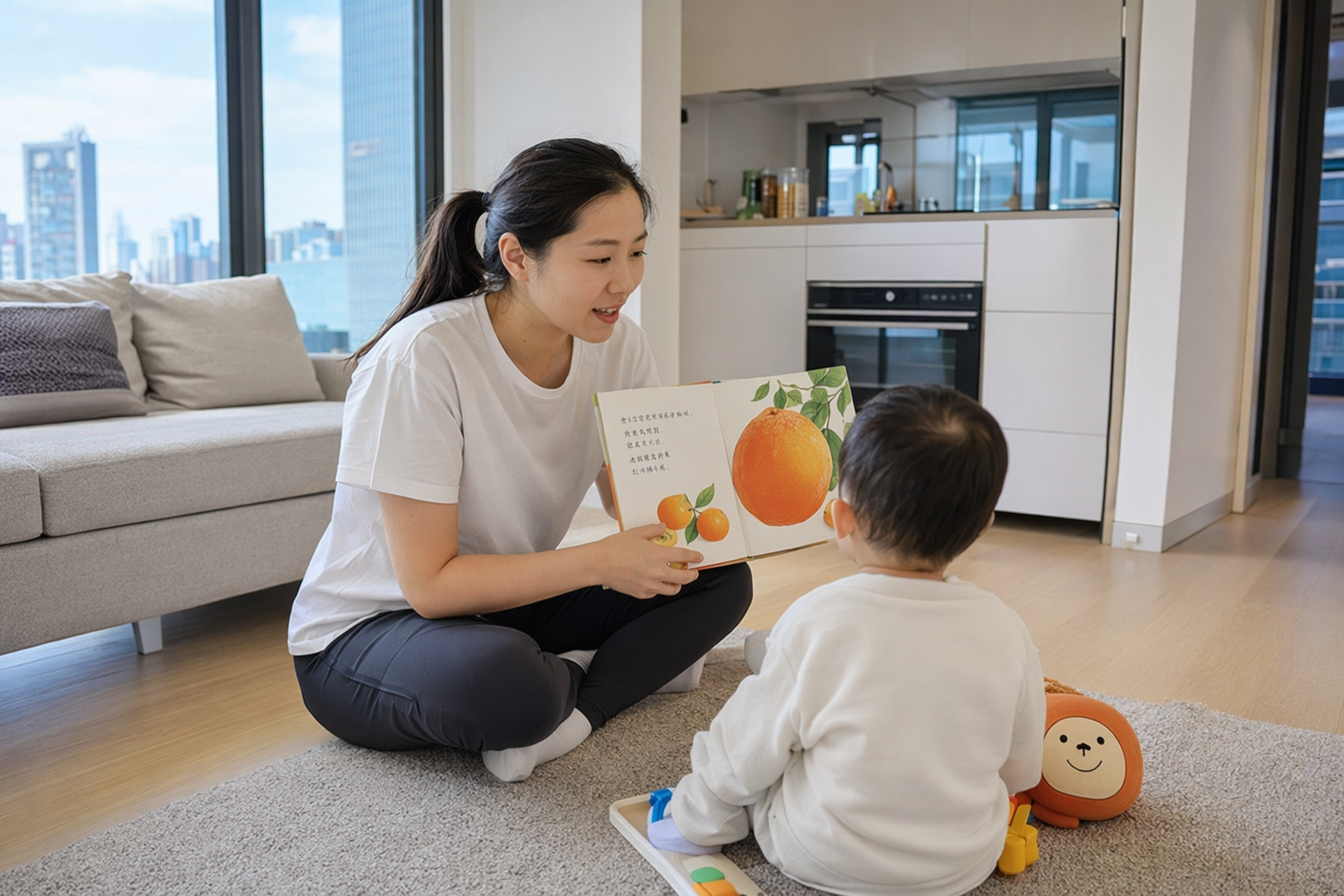
Quiet play / books | Picture book reading in Mandarin; she reads, child points + names |
11:30–12:30 |
Lunch | Food naming, simple sentence frames ("我要 X") |
12:30–15:00 |
Nap | Pre-nap Mandarin lullaby / story |
15:00–16:30 |
Snack + activity | Counting in Mandarin, simple songs |
16:30–18:00 |
Active play / outing | Same as morning, different vocabulary |
18:00–19:00 |
Dinner + bath | Family transition; nanny ends; parents take over |
Preschool (3–5 years), 07:00–19:00:
| Time | Block | Mandarin focus |
|---|---|---|
07:00–08:00 |
Wake, dress, breakfast | Conversation about what's planned today |
08:00–13:00 |
School (Mandarin-medium) | Outsourced to school; she picks up and drops off |
13:00–14:00 |
Lunch + quiet wind-down | Conversation about school day |
14:00–15:30 |
Activity / outing / playground | Free-play Mandarin |
15:30–16:30 |
Character literacy (see character literacy) | 15–30 min structured character practice |
16:30–17:30 |
Snack + Mandarin-medium screen content | Curated Bilibili or CCTV kids content |
17:30–19:00 |
Active play, dinner prep | Cooking together with Mandarin commands |
Primary (5–8 years), 07:00–19:00:
| Time | Block | Mandarin focus |
|---|---|---|
07:00–08:00 |
Breakfast + school prep | Conversation; nanny tests Mandarin homework if any |
08:00–15:00 |
School | Outsourced |
15:00–16:00 |
After-school pickup + snack | Conversation about school day |
16:00–17:00 |
Homework supervision | Mandarin homework with nanny; English homework with parents |
17:00–18:30 |
Free play / outing / Mandarin enrichment activity | Free-play Mandarin |
18:30–19:00 |
Dinner transition | Nanny ends; parents take over |
In all three bands, the Mandarin-only rule holds for the entire window when the nanny is the primary caregiver. The household-wide language rule can be different — see English creep for how to manage the broader-household language pattern.
What expat families typically get wrong
- Vague immersion goals. "We want her to speak Mandarin to the kids a lot." Doesn't define the boundary, doesn't give the nanny enforcement license, leaves both sides guessing.
- Parents undercutting in real time. Mid-immersion-day, the parent walks in, speaks English to the child, and the bubble pops. Set the boundary: when the nanny is on-duty, the household speaks Mandarin to the child, even if the parents are present briefly.
- No structured production blocks. The nanny narrates all day; the child listens; the child never has to produce. Result: comprehension high, production low. Build in
2–3activities per day that require child language production. - Switching to English when the child gets frustrated. Tempting and undoes a week of immersion work. Train the nanny to hold the line — slow down, scaffold, repeat, gesture; don't switch.
- No character literacy structure. For
3+years,15–30 minutes/dayof structured character practice is the difference between "speaks Mandarin" and "speaks and reads Mandarin." See character literacy for the routine. - No measurement. No idea whether it's working. Set a quarterly check-in: vocabulary list, comprehension test, a video of the child speaking Mandarin to compare against
90 dayslater.
Step-by-step — what to do this week
- Decide which age-band template applies. Or build a hybrid if you have multiple children.
- Brief the nanny on the Mandarin-only rule. Walk through the routine block by block. Make clear: she doesn't switch to English, ever, during her working hours.
- Brief the family. Parents don't undercut in real time. The boundary is the working window.
- Set up the activity blocks. Buy the picture books, queue the curated Mandarin-medium screen content, plan the outings.
- Start the character literacy routine if the child is
3+. - Record a baseline.
2-minutevideo of the child speaking Mandarin at the current level. Date it. - Run for
90 days. - Re-record at day
90. Compare. Adjust.
Red flags and what to push back on
- A nanny who switches to English when the child resists. Train; if she can't hold the line, it's a fit signal.
- Parents undercutting. Most common failure mode. Address it as a household-rule problem, not a nanny problem.
- No measurable language production after
90 days. Either the routine isn't immersion, the structure isn't generating production blocks, or the candidate isn't right for the role. Diagnose specifically. - A routine that's just "a lot of Mandarin" without structure. Not immersion. Restructure.
- Child showing language anxiety / refusing to speak. Real and worth addressing kindly. Don't push through; back off, scaffold more, increase positive Mandarin associations before more production demands.
The single highest-leverage immersion activity for under-`5`s is cooking together. The kitchen has high-frequency vocabulary (`水` `油` `盐` `糖` `切` `搅` `烫` `好了`), repeated actions, and natural turn-taking. `30 minutes` of cooking with the nanny daily generates more language production than `2 hours` of free play.
Common questions
Is real Mandarin immersion possible with one nanny?
Is this different for live-in vs live-out?
How does this compare to other Asian expat hubs?
What if the agency or candidate pushes back?
Where can I get a contract template that handles this?
In plain English:real immersion is `12` structured hours with Mandarin as the only working language, activities that force the child to speak (not just listen), and a household rule the parents don't break.
Run real immersion, not a vibe
We help bilingual-immersion families build a structured 12-hour routine with the nanny, the household, and the broader input environment aligned.